
Facility Automation
The Self-Storage Operator's Technology Dictionary (2026 Edition)
It’s hard to assess your options when you don’t have the right vocabulary to describe them.
I’m going to solve this problem for you in the next five minutes. Just keep on scrolling!
There’s no question that self-storage operators are curious about technology adoption. AI has, without a doubt, done a lot to spark interest in new tools for facilities.
I’m still seeing quite a bit of hesitation from operators, which I believe partly comes from not fully understanding the technical jargon.
You’ll hear terms such as "NLP model" and "RAG architecture" getting thrown around and not have a clue what they mean.
Unless you’re on the cutting edge of this stuff, it’s pretty difficult to keep up with the lingo!
That's why I’ve spent a bit of time this morning writing out a technology dictionary for you.
I've organized it into subgroups by theme so it reads like a reference guide.
Jump to what you need or read it straight through.
Either way, I hope you’ll come away with a clearer picture of what these tools really do and why they matter for a self-storage business like yours.
Your Self-Storage Operator's Technology Dictionary
Self-Storage Technology
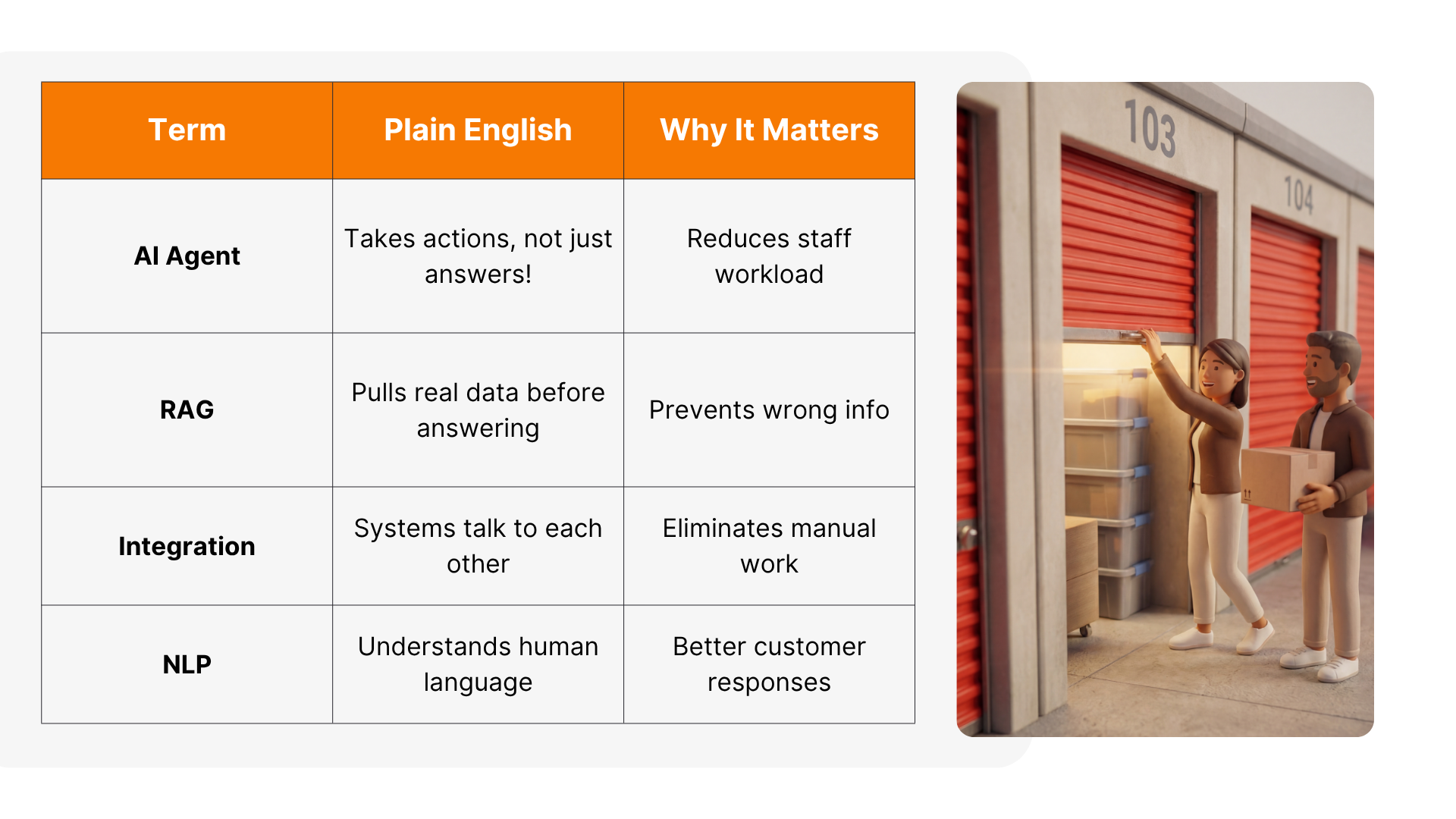
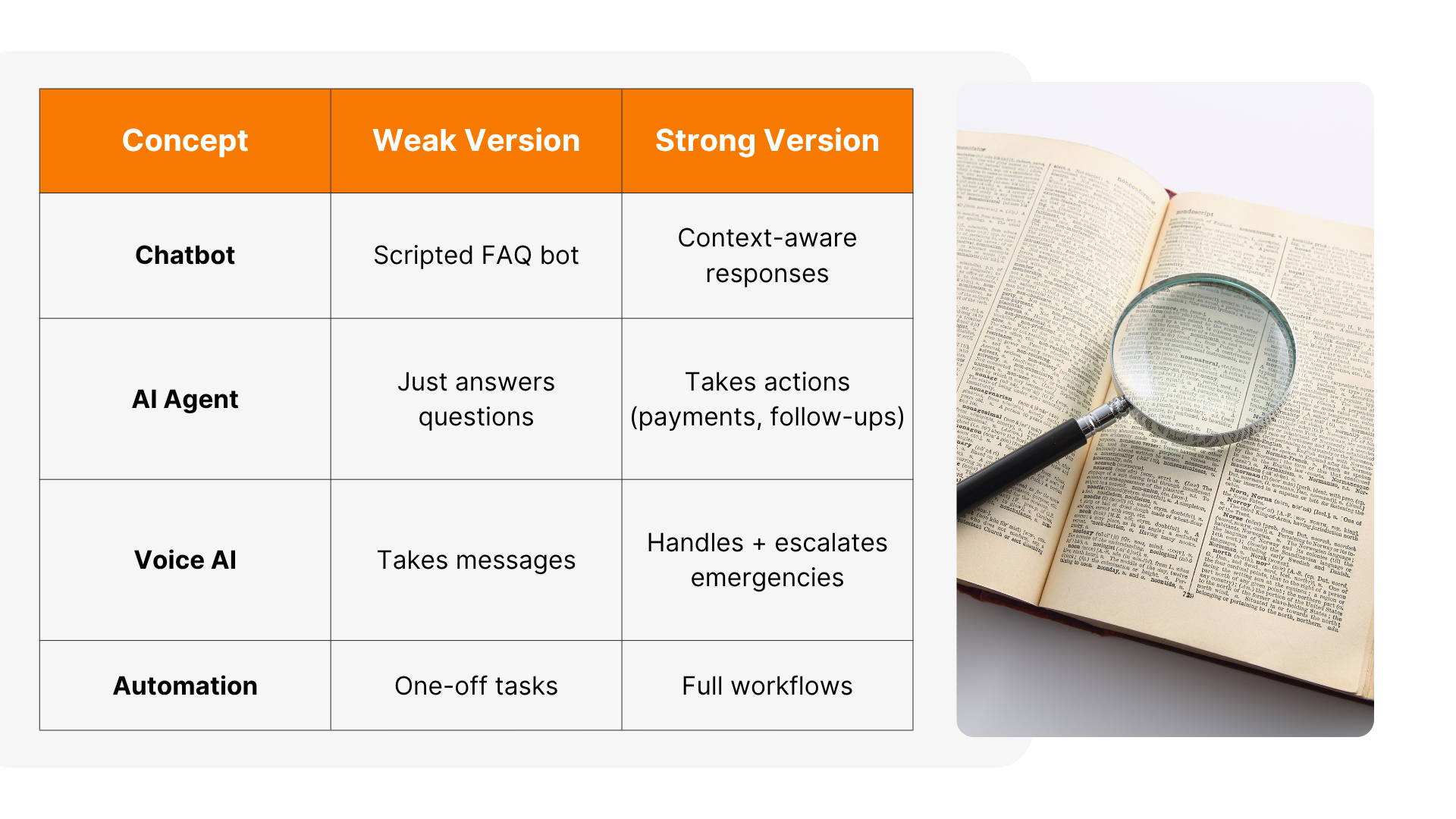
Agent (AI Agent)
Not a chatbot!
An AI agent is a system that can take actions on behalf of a customer or operator without needing a human to step in at every decision point.
A properly configured AI agent for self-storage can…
- Answer a question
- Check inventory
- Process a payment
- Send a move-in confirmation
- Follow up two days later
It can do all of this without anyone touching a keyboard.
That matters because a lot of products marketed as "AI agents" are still essentially FAQ bots dressed up in new language. Totally different.
Automation
Automation is obviously a broad category and it covers any process your system handles without requiring a staff member to manually do it.
Here are four examples:
- Collecting rent reminders
- Sending gate codes after move-in
- Flagging delinquent accounts
- Soliciting reviews after a lease signing
These are all automations! I think the value of automation in self-storage is really all about consistency.
A well-built automation runs at 2am the same way it runs at 2pm and operators love that.
Chatbot
This is a software program that takes care of customer conversations through text.
Chatbots range from very basic (scripted response trees that branch based on keyword matching) to super sophisticated systems trained on thousands of real conversations.
In self-storage, the gap between a basic chatbot and a purpose-built one is often pretty big.
A generic chatbot doesn't know the difference between a tenant asking about unit availability and a tenant reporting a flood.
A good one does… and it responds accordingly.
Containment Rate
The percentage of customer interactions your AI takes care of without escalating to a human agent.
An 80% containment rate means 80 out of every 100 conversations reached a resolution through automation alone.
I've found that operators focus too much on whether AI "can answer everything" and not enough on whether it's handling the right 80% so their team can focus on the remaining 20% that really need humans in the mix.
FMS (Facility Management Software)
Yes, this is the operational core of a self-storage facility.
Your FMS stores tenant records, unit inventory, payment history, lease agreements, and access control data.
You’re probably heard of a few popular FMS solutions such as SiteLink, StorEdge, Hummingbird, and Storage Commander.
Most modern AI tools connect to your FMS via integration so they can pull live data instead of relying on static information that goes out of date.
Hallucination (AI Hallucination)
When an AI model generates a confident-sounding response that is factually wrong.
The term sounds alarming, but the practical implication for operators is straightforward... if your AI system isn't grounded in your actual facility data, it will occasionally invent information from thin air.
Telling a prospect that a unit is available when it isn't, or quoting a rate that doesn't match your current pricing, are the kinds of errors that will damage trust in your facility.
RAG architecture (see below) is the most common solution.
Integration
A technical connection between two software systems that allows them to share data automatically.
When your AI chatbot pulls live unit availability from your FMS, that's an integration at work.
The more your tools are integrated, the less manual data entry your team has to do and the less likely a customer is to receive outdated information.
Natural Language Processing (NLP)
The branch of AI that allows software to understand and interpret human language.
This is what makes the difference between a system that only recognizes the word "payment" and one that understands "I think my card expired and I haven't been able to log in" as a billing issue.
NLP quality varies significantly between products.
Systems trained specifically on self-storage conversations will outperform general-purpose models on industry-specific requests.
RAG (Retrieval-Augmented Generation)
A technique that makes AI responses more accurate by grounding them in real, specific data before generating a reply.
Instead of generating an answer purely from its training, a RAG-powered system pulls relevant information from your actual knowledge base or FMS first, then uses that to construct a response.
For self-storage, this means your AI can answer questions about your specific facility, your rates, and your policies rather than just trying to make some educated guesses.
Unified Inbox
A single interface that consolidates all customer communication channels, phone calls, SMS, web chat, email, into one view.
For teams managing multiple locations, a unified inbox is really the difference between chasing messages across five different platforms and having a complete picture of every tenant interaction in one place.
It also enables better performance tracking across channels.
Voice AI
AI-powered voice systems that can…
- Take care of inbound phone calls
- Respond to tenant questions
- Process requests without an operator
Voice AI in self-storage is being used to answer after-hours calls, provide gate codes, collect payments over the phone, and route real emergencies to the right manager.
It should be noted that not all voice AI systems have emergency escalation logic built in, and that distinction is important to ask about before you buy.
Workflow
A defined sequence of automated actions triggered by a specific event.
A move-in workflow might automatically send a welcome SMS with gate access instructions, followed by a review request seven days later, followed by a payment reminder five days before the next billing date.
I think the quality of a platform is often determined less by individual features and more by how flexible and configurable the workflows really are.
Operations & Automation
After-Hours Escalation
The process by which a critical situation reported outside business hours gets routed to a human manager immediately rather than sitting in a queue until morning.
We’re talking about things like…
- Fire
- Flooding
- A tenant trapped on site
- A robbery in progress
We know that these obviously aren't situations where a voicemail is an acceptable response.
Good after-hours escalation means the right person is notified via text and email within seconds of a critical report, no matter what time it is.
Collections Automation
A sequence of automated communications triggered when a tenant account goes past due.
Typically involves timed SMS or email reminders before the due date, a notice on the due date, and escalating messages at defined intervals afterward.
Collections automation reduces delinquency by catching forgetful payers and expired cards before they reach late fee thresholds, which is better for the tenant and for your NOI.
Delinquency
When a tenant account becomes past due.
Delinquency rates are one of the cleaner indicators of how well your communication and collections process is working.
High delinquency usually signals either a billing friction problem (card updates not being prompted) or a reminder gap (tenants not receiving enough warning before fees trigger).
Dynamic Pricing
A pricing strategy in which unit rates adjust automatically based on real-time data, typically occupancy levels, competitor pricing, and seasonal demand.
When a unit size crosses 90% occupancy, dynamic pricing logic raises the street rate.
If occupancy drops, rates adjust to attract rentals.
Operators who implement this well stop thinking about pricing as something they set once and revisit quarterly.
Move-In Automation
A set of triggered actions that fire when a new lease is signed.
This usually will include a welcome message, gate code delivery, access hour confirmation, and move-in instructions.
What facility operators are trying to do here is give new tenants everything they need without requiring staff members to manually send it.
Well-built move-in automation also sets the tone for the tenant relationship from day one.
NOI (Net Operating Income)
Gross revenue minus operating expenses, before debt service.
The metric that most operators, investors, and lenders care about most.
Automation and AI affect NOI in two ways…
- Reduced labor costs
- Captures revenue that would otherwise be missed.
I’m talking about after-hours leads and unresolved delinquencies.
I think people often forget that capturing a few missed leads per week compounds over time.
Remote Management
Operating one or more self-storage facilities without on-site staff present at all times.
Remote management has become more viable as AI, automation, and access control technology have improved.
I’ve found that the facilities doing this well have usually invested in…
- Unified communication platforms
- Smart access systems
- AI agents
These handle the bulk of tenant requests without requiring a manager to pick up the phone.
Self-Storage Marketing & Data
Economic Occupancy
The percentage of potential gross revenue you're really collecting, factoring in discounts, concessions, and delinquency.
A facility at 97% physical occupancy could be at 85% economic occupancy if street rates have been discounted heavily to fill units.
You should track both numbers because one tells you how full you are and the other tells you how profitable you are.
Google Business Profile (GBP)
Your facility's listing on Google, which appears in Maps results and local search.
The GBP is often the first thing a prospective tenant sees and it carries significant weight in local search rankings.
Hours, photos, reviews, and response patterns all factor into how it performs.
A surprising number of operators still have outdated hours or incorrect phone numbers showing on their profiles.
KPI (Key Performance Indicator)
A metric used to measure progress toward a specific goal.
For self-storage marketing, useful KPIs include cost per move-in by channel, lead-to-rental conversion rate, call answer rate, review count and average rating, and net move-in change week over week.
The mistake I've seen repeatedly is operators tracking activity (how many ads ran, how many emails sent) rather than outcomes (how many move-ins those activities produced).
Lead Conversion Rate
The percentage of inquiries that result in a completed rental.
Conversion rates vary significantly by channel.
Walk-ins tend to convert at higher rates than web leads, but web leads are often generated at lower cost.
You need to understand conversion by channel because it tells you where your money is working and where it's leaking out.
Marketing Cost Per Move-In
Total marketing spend divided by the number of move-ins attributed to that spend, calculated per channel.
This is the metric that separates useful marketing analysis from vanity metrics.
Cost per lead sounds good but tells you nothing about profitability. Cost per move-in tells you whether your marketing is really producing rentals at a sustainable acquisition cost.
Physical Occupancy
The percentage of your units that are currently rented.
The most commonly tracked occupancy figure and the one most operators lead with.
Useful as a baseline indicator but not a complete picture on its own, particularly if street rates have been discounted to maintain it.
Revenue Per Square Foot
Gross rent divided by total rentable square footage.
It's interesting to see how rarely operators track this even though it's one of the clearest indicators of pricing health.
If occupancy climbs but revenue per square foot stays flat or drops, your pricing isn't keeping pace with demand.
UTM Tracking
A system of tags appended to URLs that tell Google Analytics where a visitor came from before arriving at your site.
A UTM-tagged link on a Facebook ad will tell you that a specific visitor came from Facebook, saw a particular campaign, and then rented a unit.
Without UTM tracking, you're looking at traffic data without knowing which channels actually drove move-ins.
Self-Storage Tenant Experience
Abandoned Cart Recovery
When a prospective tenant starts the rental process online but doesn't complete it, an automated follow-up sequence triggered by that incomplete checkout is called abandoned cart recovery.
Timing matters significantly here.
A message sent within an hour of abandonment performs substantially better than one sent the following day.
Digital Property Manager
A term used to describe the combination of AI tools, automated workflows, and self-service capabilities that allow tenants to get most of what they need without speaking to a staff member.
Gate codes, payment processing, account updates, unit questions.
When these are handled effectively by digital systems, your on-site team can focus on the situations that genuinely benefit from a human touch.
Escalation Logic
The rules built into an AI system that determine when and how a conversation gets routed to a human.
Good escalation logic distinguishes between routine questions (which automation handles) and situations that need a person, whether that's a hot lead about to rent, an upset tenant, or a genuine emergency.
Without escalation logic, AI systems either handle everything badly or handle nothing well.
Omnichannel Communication
Providing consistent support and service across multiple communication channels simultaneously, including voice, SMS, email, and web chat, in a way that is coordinated rather than siloed.
The practical implication for operators is that a tenant who texts about an issue and then calls a few minutes later shouldn't have to start the conversation over.
Their context should follow them across channels.
Review Solicitation
The automated or manual process of asking tenants to leave a review after a move-in or at a defined point in their tenancy.
The data consistently shows that asking at the right moment produces dramatically better results than hoping tenants will leave reviews on their own initiative.
When I speak with operators who have strong review profiles, almost all of them have a systematic, often automated, process behind it.
Tenant Self-Service
Features and tools that allow tenants to manage their own accounts without staff involvement.
This might include paying a bill, retrieving a gate code, updating contact information, or scheduling a move-out.
The more of this a tenant can handle on their own schedule, the less pressure is placed on your team and the more satisfied most tenants are with the experience.
Knowing These Techy Terms Means You Can Ask The Right Questions
This obviously isn’t an exhaustive list of terms. We know that the industry’s vocabulary will keep evolving as the technology does.
I was talking with Rodolfo, our Chief Operating Officer, about how often operators come into demos already knowing the terms but not yet knowing how the pieces fit together in practice.
Most operators seem to get stuck in that gap between vocabulary and application.
I think the definitions above are a starting point.
The next step is understanding which of these concepts are already active in your operation and which gaps are costing you the most in missed leads, avoidable delinquency, or after-hours coverage failures you may not have even flagged yet.
If you want to see how these systems work in practice across a real self-storage operation, book a demo with the swivl team and we'll walk you through it.
.jpg)