
Facility Automation
Self-Storage Emergency AI: Best & Worst Options For Critical Situations
Real emergencies at self-storage facilities don't follow business hours.
Facility owners who've been in the industry long enough know that how you respond to a genuine crisis shapes your liability, your reputation, and your tenants' safety more than almost anything else.
Here are just three examples...
- A tenant trapped inside a unit after hours.
- A flood spreading through a row of climate-controlled units at 2am.
- A fire or robbery in progress with nobody at the facility to respond.
Don’t mistake these as minor inconveniences! There are situations where the time between the incident and the right person being notified can have serious consequences.
AI is changing what's possible here, but most of what's marketed as emergency AI for self-storage is built for forgotten gate codes rather than genuine crises.
I'm going to walk you through what really matters for critical after hours situations in 2026.
But first, before we start adding tools to your technology stack, I need to tell you what to avoid.
Here's What I Want You To Avoid…
Voicemail-Based "AI" Systems
The bottom of the barrel. These systems answer calls after hours, use voice recognition to categorize the issue, and then... leave a message for someone to follow up in the morning.
A tenant reporting a fire or a flood gets a robotic voice telling them their concern has been noted. Many operators are still paying monthly fees for systems like these. Completely unacceptable for anything that constitutes a real emergency.
Generic Chatbots With No Escalation Logic
A chatbot that can't distinguish between a tenant asking about pricing and a tenant reporting a robbery is not an emergency system.
If a critical situation comes in and the bot has no escalation logic, it either sends a canned response or routes to a queue that nobody monitors overnight.
Generic chatbots built on broad AI models without self-storage-specific emergency training fall into this category consistently.
Single-Channel Solutions With No Manager Alerting
As you've likely experienced, critical situations require immediate human awareness, not just an automated response on one channel.
A tenant reporting water damage might call, then text when nobody answers.
AI that only covers one touchpoint while sending no outbound alerts to your team creates exactly the kind of coverage gap that turns a manageable incident into a serious liability.
If your system isn't actively notifying the right people the moment a critical situation is reported, you may as well not have one.
What Does Good Emergency AI Look Like For Critical Situations?
The best emergency AI for self-storage in 2026 shares a few traits that separate it from everything listed above.
It Knows The Difference Between Urgent And Critical…
A question about unit pricing at 10pm is routine. A tenant reporting a fire or a flood at 10pm requires immediate human escalation.
The best systems are trained to recognize that distinction and respond accordingly, alerting the right people in the moment rather than routing every after hours contact the same way regardless of what's really happening at your facility.
It Notifies The Right People Immediately
swivl's after hours emergency voice feature takes care of exactly this.
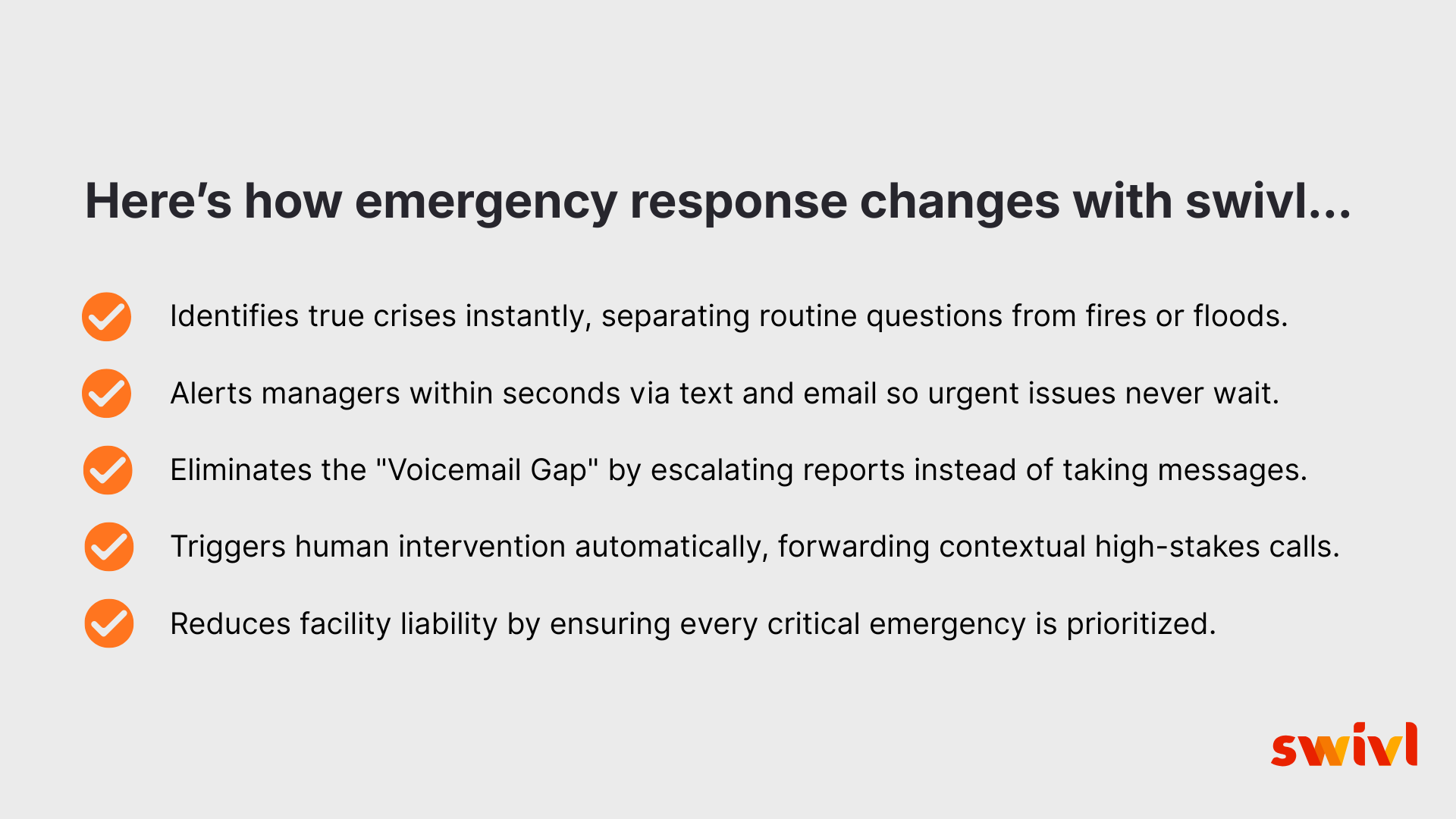
When a caller reports a critical situation outside your defined business hours, whether that's a trapped tenant, a robbery, a fire, or a flood, swivl automatically sends text and email notifications to the facility managers you assign.
You can also forward the call directly to a dedicated number if the situation requires it.
This means urgent situations reach the right people within seconds and not the following morning!
Most Critical After Hours Calls Follow Recognizable Patterns…
Facility owners are surprised when they look at the data on what genuinely escalates overnight.
The situations that require immediate manager notification tend to cluster around a small number of recognizable scenarios:
- Tenants trapped inside a unit or on the property
- Reports of fire, smoke, or flooding
- Robberies or break-ins in progress
- Structural or access failures that prevent safe exit
swivl's after hours emergency voice feature is trained to identify these situations and escalate them automatically, which means your managers are notified the moment something serious happens rather than discovering it when the office opens!
It Reduces Reliance On Expensive Third-Party Emergency Services
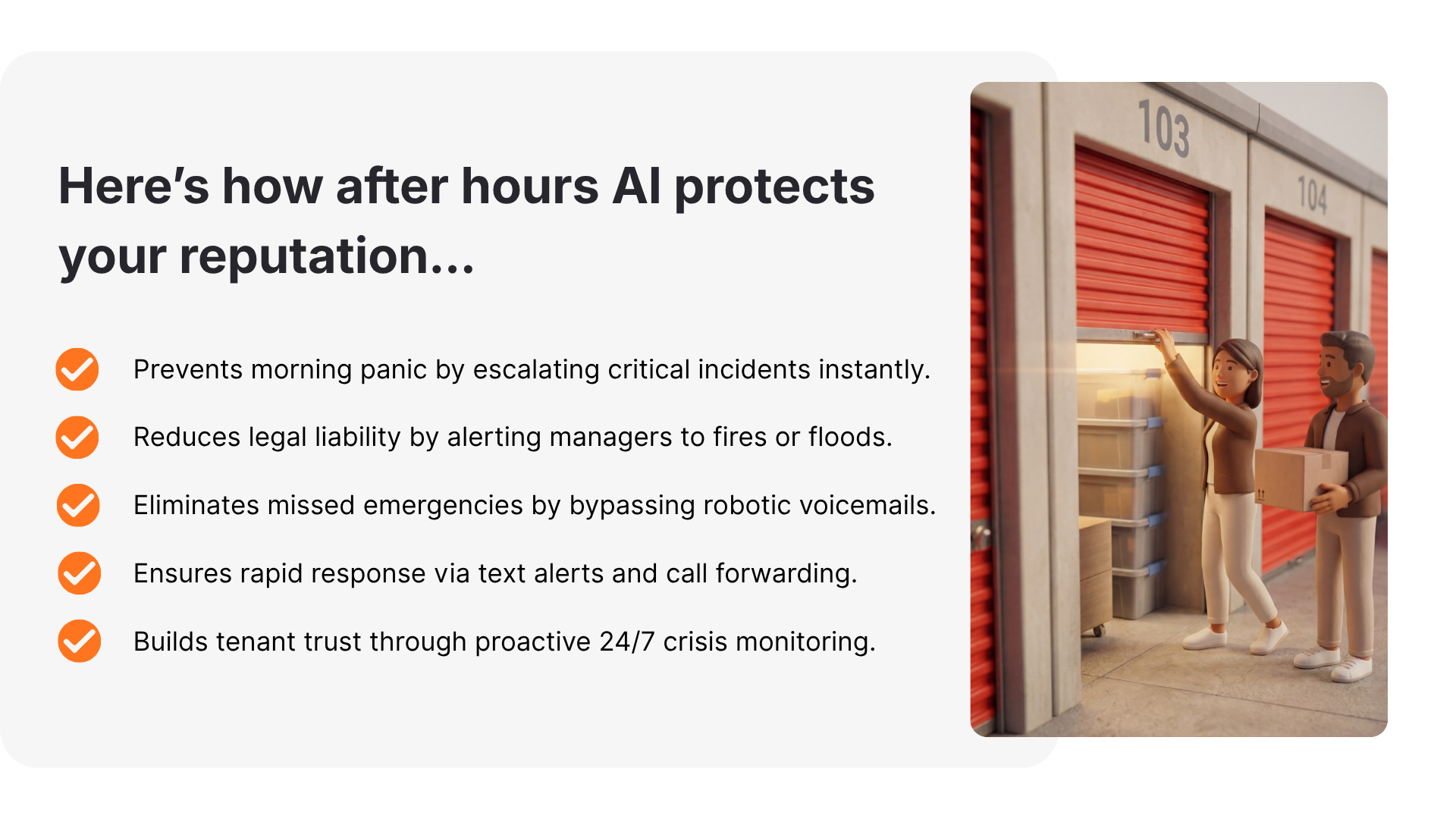
swivl takes care of critical after hours escalation through a single platform, and the alerts reach your assigned managers directly via text and email.
A situation reported at 2am gets the same immediate escalation path as one reported at 2pm, without requiring a third-party answering service that has no context about your facility or your team.
In a genuine emergency, that directness and that context are what actually matter.
Track These Four Metrics For Critical Emergency Response
Facility owners often measure call answer rates and stop there.
I think it's worth remembering that answer rate is only one part of the picture when real emergencies are involved. Here’s what you need to focus on…
- Time from emergency report to manager notification.
- Rate of critical situations correctly identified and escalated.
- Manager response time following an after hours alert.
- Incidents resolved without needing third-party emergency services.
swivl surfaces after hours activity inside a unified inbox where every interaction is logged, summarized, and scored.
When I speak with operators using the platform, they appreciate the peace of mind, knowing a serious incident at 3am will reach the right person within seconds.
They don’t want an incident like this left unaddressed until Monday morning.
Can You Really Afford No Critical Escalation Path After Hours?
Every facility carries real liability exposure overnight, and a single serious incident that goes unaddressed because nobody was notified in time is the kind of event that ends up in legal proceedings, not just a bad review.
There's no room for error!
The facilities taking this seriously treat after hours critical escalation as a core part of their risk management rather than an afterthought.
swivl's after hours emergency voice feature is available on the Disruptor tier, already built, already configured for critical situation escalation, and ready to deploy across your locations with manager notifications via text and email and optional call forwarding for situations that require it!
Book a demo with the swivl team today and see what real after hours emergency coverage looks like when it's built for the situations that really matter.
.jpg)