.png)
Contact Center
AI-Powered Call Center For Self Storage: Best & Worst Options
What if the calls you're missing on weekends are costing you more than your entire call center budget?
A facility operator told me last month that they paid $4,000 in call center fees during March.
When we pulled the data, the call center had converted exactly three rentals that month.
That's $1,333 per rental! Half the prospects who called complained about being transferred multiple times or getting vague answers about unit availability.
The operator kept paying because missing calls felt worse than overpaying for bad service. This is the reality most operators face.
Traditional call centers handle overflow, but they don't actually solve the problem. AI-powered call centers are changing this, but not all of them work the same way…
I'm going to walk you through what's actually available, what works, and what's just expensive noise.
Traditional Call Centers Were Never Built For Self Storage
Call centers solve one problem...
Someone answers the phone, but answering isn't the same as converting.
When a prospect calls asking about climate-controlled units, your call center agent might know the general price range. They probably don't know which specific units are available right now and can't pull up your property management system to check real-time availability.
So they take a message, transfer the call, or give a generic answer and hope the prospect calls back during business hours.
I've noticed that prospects rarely call back. They rent from whoever gives them a real answer first.
Here's where I see traditional call centers break down...
They Can't Access Your Systems
Most call center agents work off a script and a basic FAQ document. When someone asks, "Do you have a 10x10 available for next Tuesday?" the agent has no way to check. They might as well guess!
Training Takes Forever & Doesn't Stick
Call center agents handle calls for dozens of different businesses. You can’t expect them to remember the intricate details of your specific facility. That’s unrealistic.
Cost Scales With Volume
More calls mean more agent hours mean higher bills. During busy seasons, costs spike just when you need efficiency most.
Quality Is Often Inconsistent
One agent might be great, another might be terrible. There's no way to guarantee every call gets handled well.
When I speak with operators who use traditional call centers, they describe it as "better than nothing."
That's not exactly a ringing endorsement.
What AI-Powered Call Centers Actually Do Differently
AI-powered call centers understand context, access your systems, and handle the entire conversation from first question to unit reservation.
The Difference Is Intelligence
A traditional call center agent follows a script. An AI system trained on hundreds of thousands of self storage conversations knows how to guide prospects toward booking without sounding robotic.
Here's what changes…
Real-Time System Access
AI can pull current availability from your property management system instantly. When someone asks about a 5x10, the AI checks your inventory and gives an accurate answer in seconds.
Consistent Quality Every Time
The AI doesn't have bad days and it won’t forget training. Every caller gets the same high-quality experience regardless of when they call.
Handles All The Complex Questions You Can Imagine
Instead of transferring calls or taking messages, AI can answer facility-specific questions about access hours, security features, or insurance requirements.
Learns From Every Conversation
Frustratingly, traditional agents forget things. They’re only human, after all! AI systems get smarter with each interaction. AI can understand which phrases lead to conversions and which create friction.
I've always found that the best AI systems are never trying to replace humans entirely. They will handle the repetitive stuff so your team can focus on conversations that actually need a human touch.
Here Are The Best AI Call Center Options Right Now
Not all AI call centers work the same way.
I’ve found that some are glorified voicemail systems with voice recognition, while others are sophisticated enough to handle everything from initial inquiry to signed lease.
Here's what's actually available...
Basic Voice AI With Limited Functionality
These systems can answer simple questions and route calls. They're cheap but limited. If someone asks anything outside the script, the system transfers them or takes a message.
AI With Property Management Integration
These connect to your PMS and can check availability, quote prices, and even process reservations. Much more useful, but requires proper setup and integration.
Full Conversational AI Platforms
swivl handles calls, texts, emails, and chat through one unified platform. The AI understands context across channels, so if someone starts on your website and then calls, the conversation continues seamlessly.
Hybrid Models
AI handles initial screening and simple questions, then transfers complex situations to human agents. This combines cost efficiency with human judgment.
I think people often forget that the cheapest option usually ends up being the most expensive when you factor in lost rentals.
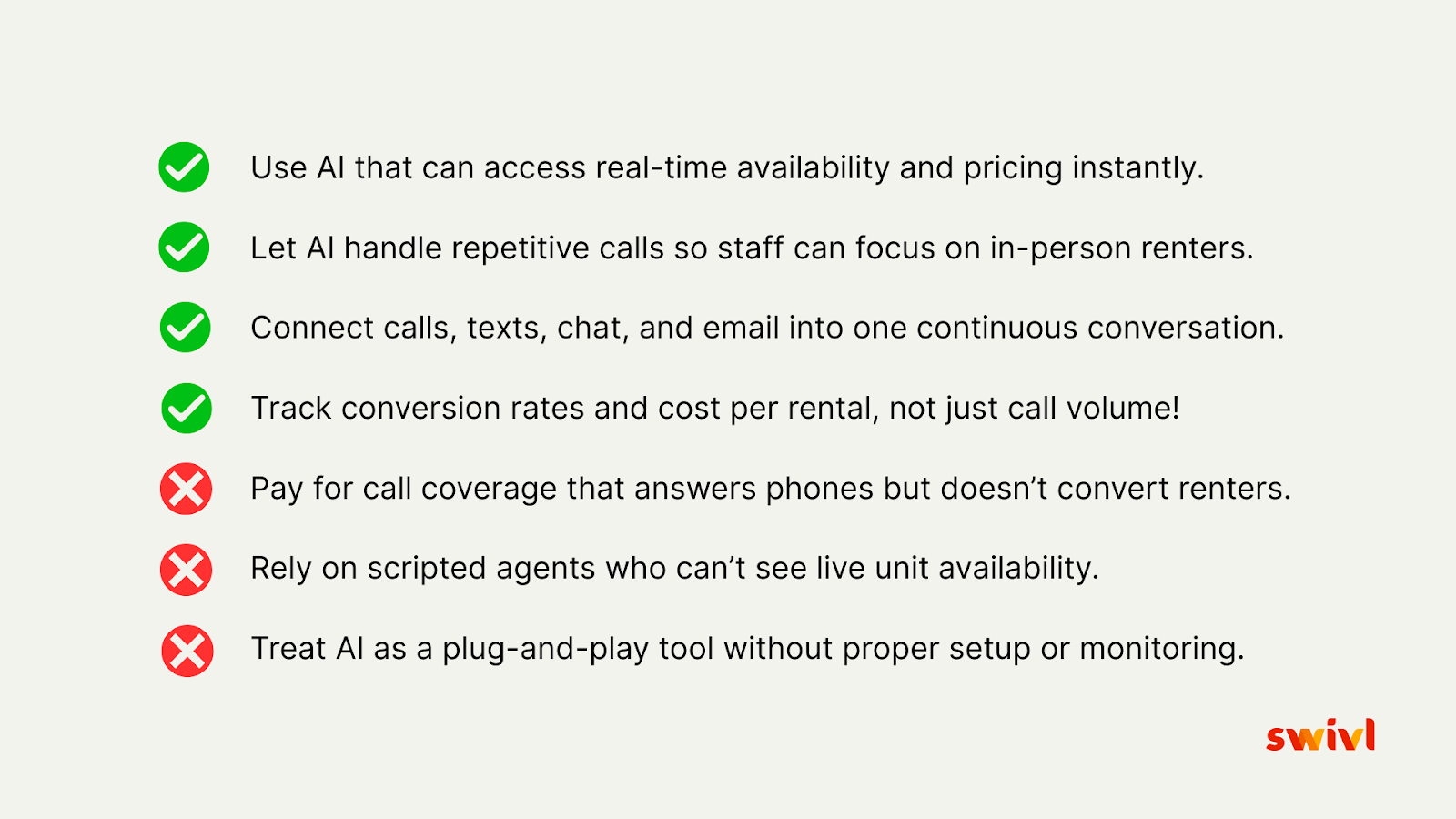
Where Most AI Call Center Implementations Go Wrong
Operators get excited about AI, sign up for a service, and then wonder why it's not working.
The problem is usually in the setup rather than the technology.
Garbage Data In, Garbage Answers Out
If you don't give the AI accurate information about your facility, it can't give prospects accurate answers. This means feeding it current pricing, unit availability, access hours, and facility-specific details.
No Integration With Existing Systems
An AI that can't check your property management system is just an expensive answering machine. Integration is where the real value lives.
Setting Unrealistic Expectations
AI won't turn every caller into a rental, but it should convert at rates comparable to or better than your in-house team for standard inquiries.
Not Monitoring Performance
You need to review calls regularly. Which questions is the AI handling well? Where is it struggling? This feedback loop is critical.
Forgetting To Train Your Team
Your staff needs to understand what the AI handles and when they need to step in. Without clear handoff protocols, things fall through the cracks pretty easily.
It's interesting to see how operators who treat AI implementation as a project rather than a "set it and forget it" tool get dramatically better results.
The Questions Your AI Call Center Should Answer Without Help
A good AI call center should handle 80% of incoming calls completely.
Here's the test…
Can your AI answer these questions without transferring to a human?
- What sizes do you have available?
- How much does a 10x10 cost per month?
- Can I reserve a unit online right now?
- What are your access hours?
- Do you have climate-controlled units?
- What forms of payment do you accept?
- Can I get in today to move stuff?
- Do you require insurance?
- Is there an elevator in the building?
- What's your security like?
If your AI needs to transfer these basic questions to a human, it's not doing its job. These are the repetitive inquiries that eat up your team's time and should be handled automatically.
When I speak with operators who've implemented good AI call centers, they report that staff time spent on phone calls drops by 60% or more... while conversions from calls actually increase because response times are instant.
I Have A Different Approach For You To Consider
Most AI call centers are single-channel solutions. They handle phone calls and nothing else.
swivl takes a different approach. The same AI that handles your phone calls also manages website chat, text messages, and emails.
This matters because prospects don't just call anymore. They text. They use your website chatbot. They send emails…
With swivl, the AI recognizes the prospect across all channels.
If someone chats on your website at 2pm asking about units, then calls at 8pm, swivl knows who they are and picks up the conversation where it left off.
Traditional call centers can't do this because they only see the phone call in isolation.
Here's what makes swivl different…
Trained On 750,000+ Self Storage Conversations
The AI understands how storage prospects actually talk and what questions they ask.
Direct Integration With Major Property Management Systems
Real-time availability, instant pricing, and actual unit reservations!
Unified Inbox For Your Team
When the AI does need to hand off to a human, your staff sees the entire conversation history across all channels.
Continuous Learning
Every conversation makes the system smarter for your facility specifically.
I think it's worth remembering that the goal isn't to eliminate human interaction. The goal is to handle repetitive questions instantly so your team can focus on prospects who need personal attention.
What To Do If Your Current Call Center Is Draining Your Budget
I know that switching from a traditional call center to AI feels risky. You're paying for something that works (sort of), and change means uncertainty.
From my conversations with facility operators, here’s how you can make a successful transition…
Run Both Systems In Parallel For A Month
Keep your existing call center, but add AI! You should compare conversion rates, cost per rental, and customer satisfaction. The data will tell you which performs better.
Start With After-Hours Only
You can let AI handle nights and weekends when your call center is most expensive. Once you're confident it works, you can then expand to business hours.
Set Some Clear Success Metrics
What's your current cost per converted rental through the call center? What's your answer rate? What's the average time from call to follow-up? I want you to measure these before and after implementing AI.
Plan For A Learning Period
In the first two weeks, the AI will need adjustments. Questions will come up that need better answers. This is normal. Don't panic and abandon the system!
Operators who make the switch report cutting call-related costs by 50% while actually improving lead conversion because response times drop from hours to seconds.
Can You Afford Not To Use An AI-Powered Call Center?
I want you to pick your biggest pain point. For most operators, that's after-hours calls or weekend inquiries.
Implement AI there first. Make sure it works. Get comfortable with how it handles conversations.
You can then expand to other channels, add text messaging, and integrate website chat.
Eventually, let AI handle daytime overflow when your team is busy with in-person visitors.
Within a few months, you'll have 24/7 coverage across every channel without the cost or inconsistency of traditional call centers.
Do you want to see how swivl can handle your calls, texts, chats, and emails through one AI-powered platform? Book a demo with our team today.