Voice AI
What Are Your After-Hours Calls Worth? A 4-Line Scorecard
If you don't count after-hours calls as revenue, you'll treat them as a cost, and you'll undervalue, or cut, the thing that books rentals while you sleep. This post gives you a 4-line scorecard for every call that comes in after close: the calls, the rentals they start, the rent those rentals carry, and how long each one takes to turn into a lease. Then it works the numbers through, so you can see what the line is worth.
It's 9 PM. Your office closed at 6. Somebody who just signed a lease on a smaller apartment is on your website, looking at a 10x10, and calls the number at the top of the page. What happens next decides whether they rent from you or from the next facility on the list.
In the State of Voice AI in Self Storage report, swivl CEO Mason Levy wrote that nobody asks about after-hours coverage anymore: "It's handled, it's invisible, it's assumed." That's true for operators running voice AI. But assumed coverage has a cost of its own. When the calls get answered and nobody counts what they earn, the after-hours line looks like a utility instead of a sales channel.
What's inside
- Key terms: after-hours call, sales call, last touch, first contact to lease
- Missed calls are missed rentals
- What a 9 PM call is asking for, and what an answering service misses
- The 4-line after-hours scorecard, with a worked example
- Two operators after close: Personal Mini and Adams
- What waits for morning
- Five checks for your after-hours line
Key Terms
- After-hours call. Any call that comes in when no one on your team is available to answer: evenings, early mornings, weekends and holidays.
- Sales call. A call from someone shopping for a unit, as opposed to a tenant calling about a gate code, a balance or a move-out. This is the denominator that matters for rentals.
- Last touch. The channel that touched the renter last before the lease was signed. If voice was the last conversation before the rental, voice gets the credit.
- First contact to lease. Days from the renter's first conversation to the signed lease.
Missed Calls Are Missed Rentals
In Q2 2026, the swivl network took 13,528 after-hours calls, each one with no person available to take it. That's not an edge case. At some operators, it's close to half the phone, and every one of those calls that goes to voicemail is a missed rental.
Most operators still talk about those calls as coverage: did someone, or something, pick up? That's the wrong frame for a renter. A renter at 9 PM doesn't want a message taken. They want a price on a unit that's really open and a way to rent it before they go to bed.
One operator put the stakes plainly on a call with us: "most of the leads by the time I see them, even if it's 5 minutes... they've already rented at another company." Storage is a reactive purchase. The shopper is moving, downsizing or clearing out a garage this week, and they rent from whoever gives them a real answer first.
What a 9 PM Call Is Asking For
After close, calls split into two groups: tenants who need something done, and shoppers who want to rent. Both are revenue. The tenant at the keypad needs the right code, and a past-due tenant needs a way to pay before they can get in. The shopper needs a price and a next step.
Here's what swivl's Voice AI does with the shopper's call:
- Answers every call, at 9 PM the same as at 9 AM.
- Checks your FMS while the caller is on the line and quotes the units that are actually open, at your current rates. It won't invent a promotion you never configured.
- Recommends a size from what the caller is storing.
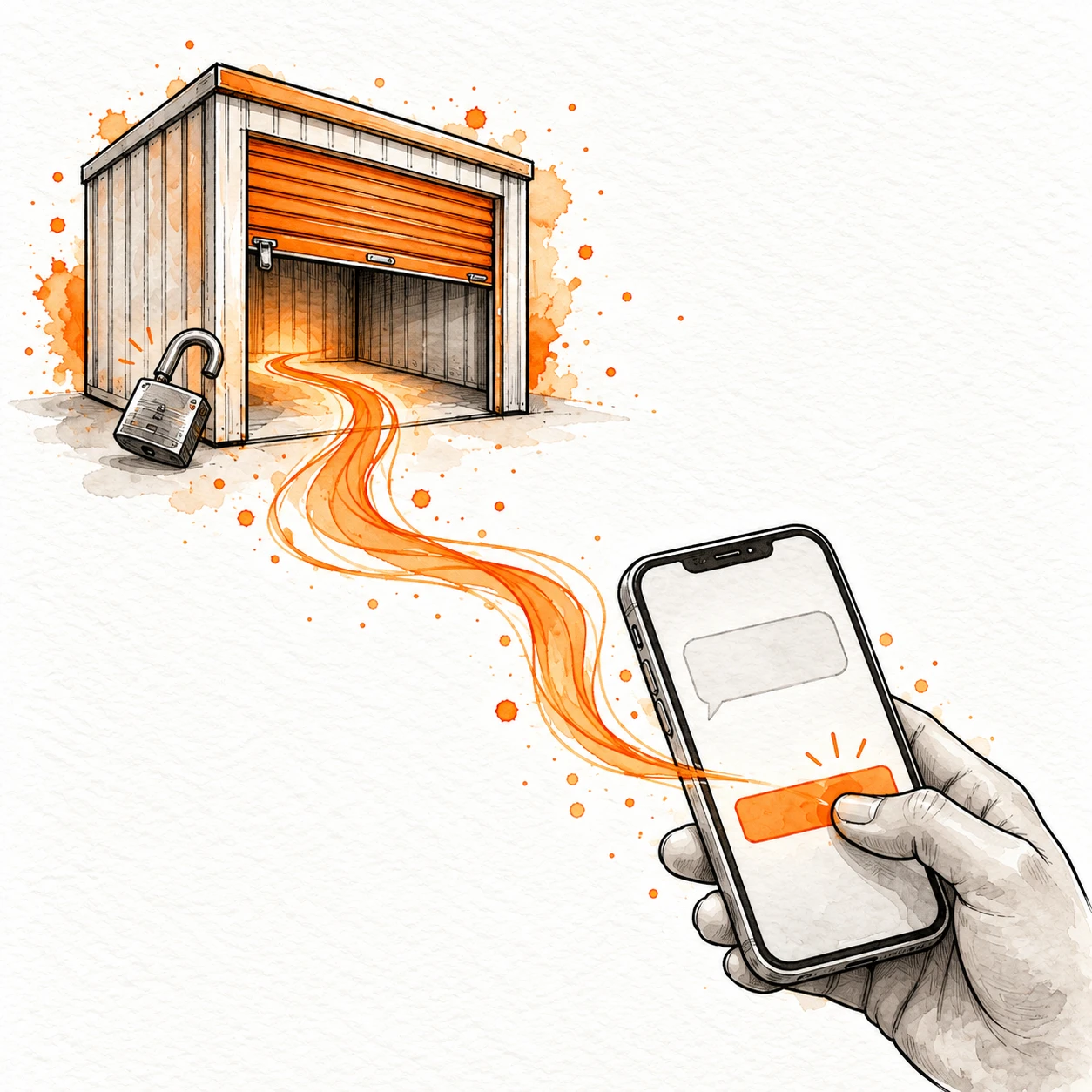
- Texts a link to finish the rental online, so the shopper can pick the unit, sign and pay on your website, on their phone, that night.
- Writes the lead and a summary note into your FMS, so whoever opens the account in the morning sees what the caller wanted and how the call ended.
Some after-hours answering services take a name and a number and promise a callback in the morning. That's a voicemail with a person reading it. A message is activity, so if you're weighing a call center alternative, ask what happens after the call, not just who picks up. In swivl, the shopper gets a real price and a rental link at 9 PM, so they have a way to finish tonight, and the morning callback becomes a follow-up instead of a first response.
The 4-Line After-Hours Scorecard
If after-hours calls are a rental line, keep a scorecard for them. It has four lines.
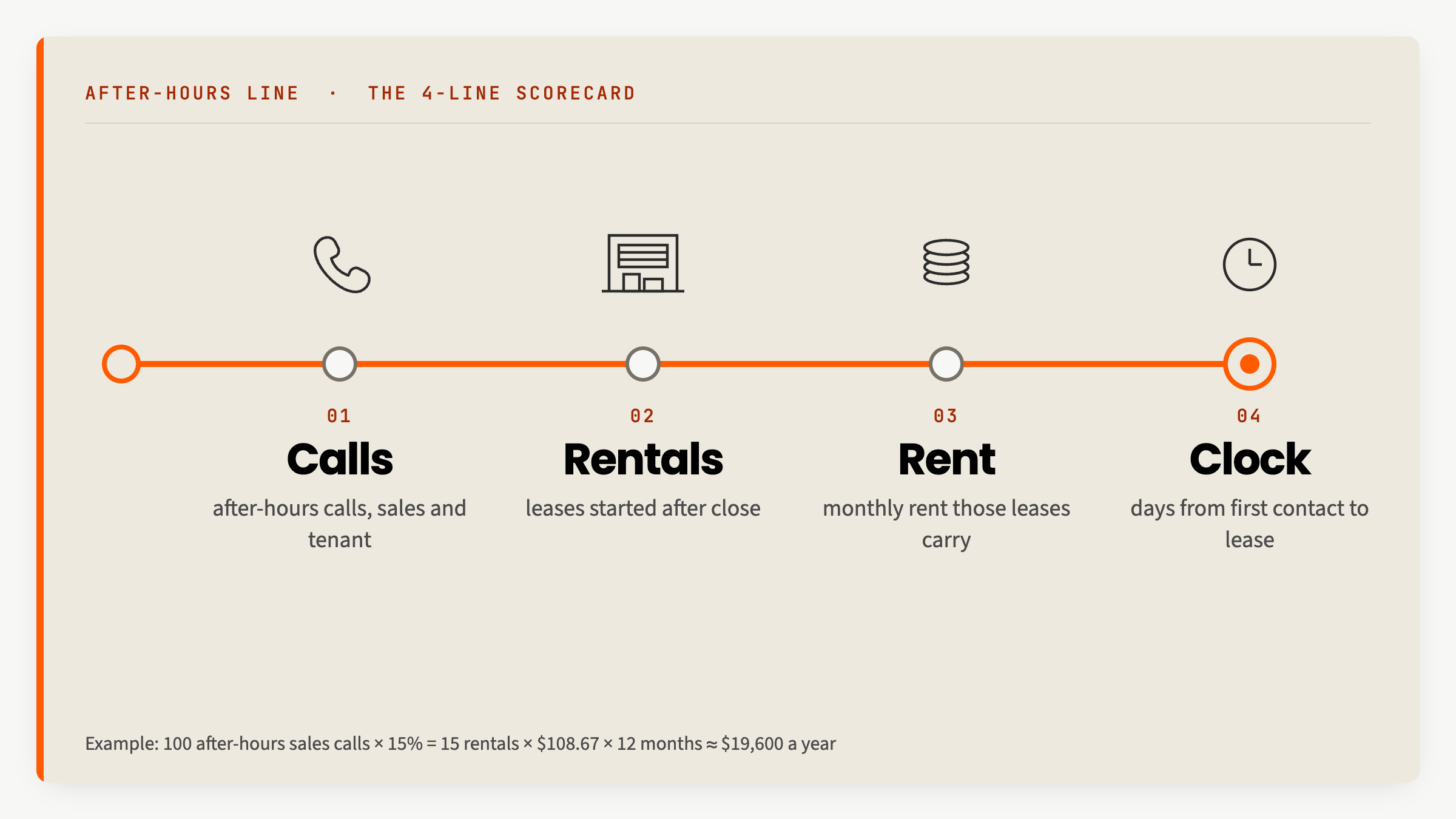
1. Calls. How many calls come in after close, split into tenant calls and sales calls.
- Done when: you know your after-hours share of total calls, by location.
- Proof: call logs by hour and by intent.
2. Rentals. How many leases started with an after-hours sales call. Count them against sales calls, not all calls, or a busy night of gate codes makes conversion look broken.
- Done when: every after-hours rental is tied back to the call that started it.
- Proof: new rentals in your FMS with voice as the last touch.
3. Rent. The monthly rent those leases carry. This is the line that goes next to what you'd pay to staff the phones after close.
- Done when: after-hours rentals have a dollar value every month.
- Proof: rent on the new leases in your FMS.
4. Clock. Days from first contact to signed lease. A renter who gets an answer at 9 PM shouldn't wait until tomorrow afternoon to start.
- Done when: you track first contact to lease and watch it move.
- Proof: the first conversation date and the lease date on each rental.
What it's worth, worked through. Here's the scorecard with example numbers. Swap in your own.
- Calls: 100 after-hours sales calls a month.
- Rentals: 15% of them rent, so 15 new leases. That's Smartlock's published sales-call conversion for May, across all hours.
- Rent: 15 leases at $108.67, the average rent on a voice-closed lease in Q2 2026, is about $1,630 in new monthly rent.
- Over a year: if those tenants stay 12 months, that's about $19,600 from one month of after-hours calls.
Put that number next to what you'd save by cutting after-hours coverage. That's the comparison a cost line never shows you.
For scale, here's the whole swivl network in Q2 2026, from the same report, across every hour of the day: 956 rentals closed with voice as the last touch, carrying about $103,740 in new monthly recurring rent at an average of $108.67. First contact to signed lease fell to 6.6 days, down from 8.7 in Q1. Your scorecard is the after-hours slice of numbers like these.
Two Operators, After Close
Personal Mini Storage, 20 locations. 48% of Personal Mini's voice calls come in after hours, and over 1,500 landed outside business hours last quarter. Every one was answered. From March to June 2026, about 9 in 10 new rentals had voice as the last touch: 144 voice rentals carrying about $19K in new monthly rent over the quarter.
The moment it clicked for Joel Patterson, SVP of Operations, was a closed Sunday. An existing tenant called needing a second unit. swivl recommended a size and moved the tenant into the online rental flow. The lease was signed in their FMS and the gate code worked, with zero people involved. Read the Personal Mini story.
Adams Property Group, 24 locations, two brands. Before swivl, calls rolled over to a live call center after a few rings, during the day and after hours. At Your Storage Units, about 22% of inbound calls now come in outside business hours, and every one gets answered. Across the portfolio, 242 rentals have had voice as the last touch, carrying about $26.4K in new monthly rent, and the call center expense came down 93% in Miles Tart's words. Read the Adams story.
Neither operator added a night shift. And neither case study splits rentals by the hour they started yet. That's the line most operators have never seen, and it's the point of keeping the scorecard.
What Waits for Morning
Not every 9 PM call should end at 9 PM. Hand off when the call needs judgment, an exception or authority the AI doesn't have:
- An emergency. The AI follows your procedure, routes the call and opens a ticket. A person owns the outcome.
- Damage or a break-in. The tenant needs a person, and the facility needs a record.
- A discount beyond what's configured. The AI can quote your policy. It can't decide to bend it.
- A caller who asks for a person. Many ask out of habit, so the AI says what it can do and asks for a shot. If they still want a person, they get one. No loops.
Anything that can wait becomes a ticket with an owner, a location and a due date. It carries the caller's identity, the account, what they asked for, what was already done and why it needs a person, with the conversation attached. Your team sees it the moment they log in. The morning starts with a list, not a voicemail box.

The AI works the night. Your team starts the morning knowing what happened.
Five Checks for Your After-Hours Line
- Call your own number at 9 PM. Ask for a 10x10. Did you get a real price on a unit that's really open, and a way to rent it tonight?
- Pull your after-hours share by location. If you don't know how many calls come in after close, you can't know what they're worth.
- Count rentals against sales calls. Tenant calls about gate codes and balances belong in the log, not in the conversion rate.
- Put a dollar value on the after-hours line every month. Rentals that started after close, and the rent they carry.
- Read the morning list. Every after-hours call that needs a person should show up as a ticket with an owner, not as a voicemail someone has to find.
For what the AI should finish on any call, day or night, see Self-Service Calls. For how to measure whether the work got done, see Contained Isn't Done.
The renter at 9 PM is ready now. Count what answering them earns before anyone calls it a cost.
Want to see what your after-hours line would book? See it in Action