Voice AI
Self-Service Calls: What Voice AI Should Finish, and What It Should Hand Off
Most calls into a self storage office are not hard. A tenant needs a gate code. A tenant wants to pay a balance. A shopper wants a price on a 10x10. A tenant is moving out at the end of the month. Each one takes a few minutes, and each one lands when your team is busy with something else, or gone for the night.
These are self-service calls. The tenant could finish the job alone if something on the other end of the line had the account, the rules and the authority to act.
The swivl network now processes 300,000+ calls a month. In the quarter covered by State of Voice AI in Self Storage, Issue 02, 13,528 of them came in after hours, with no person available to take them. Whether AI can pick those calls up is settled. The real questions are which calls it should finish on its own, how it gets them right, and what happens to the rest.
A Routine Call Is a Job, Not a Question
A self-service call ends well when the work is done, not when the line goes quiet. Here is what swivl's Voice AI does on five routine calls, what done looks like, and where you can prove it:
- Gate code. Verifies the caller, checks the account, then gives the code. A past-due tenant gets the balance and a way to pay it. Once the payment posts, they get the code. Done when: the tenant is through the gate. Proof: the gate access log.
- Balance and payment. Reads the balance from your FMS and texts a secure payment link through spot by swivl. The account is already open, and the tenant pays with Apple Pay, Face ID or card. Done when: the payment posts. Proof: the payment ledger in your FMS.
- Price and availability. Checks your system while the caller is on the line and quotes what is actually open. It won't invent a promotion you never configured. Done when: the caller has a real price on a unit that is really open. Proof: unit status in your FMS at the time of the call.
- Reservation. Quotes what's open, then completes the rental on the call or texts a link to finish later. Done when: the lease is signed. Proof: the new rental in your FMS.
- Move-out. Takes the details and the date, then routes the request as a ticket with an owner, a location and a due date, so someone closes the account. Done when: the account is closed. Proof: the closed ticket and the closed account in your FMS.
When the conversation ends, swivl writes a summary note to the tenant's FMS account: the channel, what they needed and the outcome. Anyone who opens the account sees how the last call went.
Accuracy Comes From the Account, Not the Voice
Every voice demo sounds good for ninety seconds. What matters is what the AI knows when it picks up, and what it can do before it hangs up.
Accuracy on a self-service call means the right person, the right account and the right answer. The AI verifies identity before it shares account details. It reads live account status and availability from the FMS instead of reciting a script. It remembers, too: a tenant who texts on Monday and calls on Tuesday is in the same conversation.
The first sentence the caller hears matters as well. Over 60 days and 2,770 calls, swivl tested six greetings against each other. The two that coached callers on exact phrases backfired, pushing escalations up as much as 6.9 percentage points above control at one site. The winner named the AI and listed what it could help with: gate access, payments, reservations, move-outs. At the site with the clearest data, it cut escalations by 2.56 points.
Network-wide, callers asking for a person up front fell from 33.6% to 25.8% over the same period.
Clarity beats coaching. Tell callers what the AI can do, then let them talk.
What Finished Looks Like
Past-due calls are the hardest self-service calls to get right, because money and a tenant's bad week meet on the same line. Here is Q2 2026 from Issue 02, split the way the report splits it:
What got handled
- 10,735 past-due tenants engaged in a live conversation.
- 94%+ needed no transfer to a person. 5.49% did.
What got offered
- 21.66% ended with a payment link sent.
What got finished
- 15.9% set up a payment plan on the call.
- 9% completed a payment, with no staff member on the line.
Along the way, collections outreach alone saved 427.71 hours of staff time.
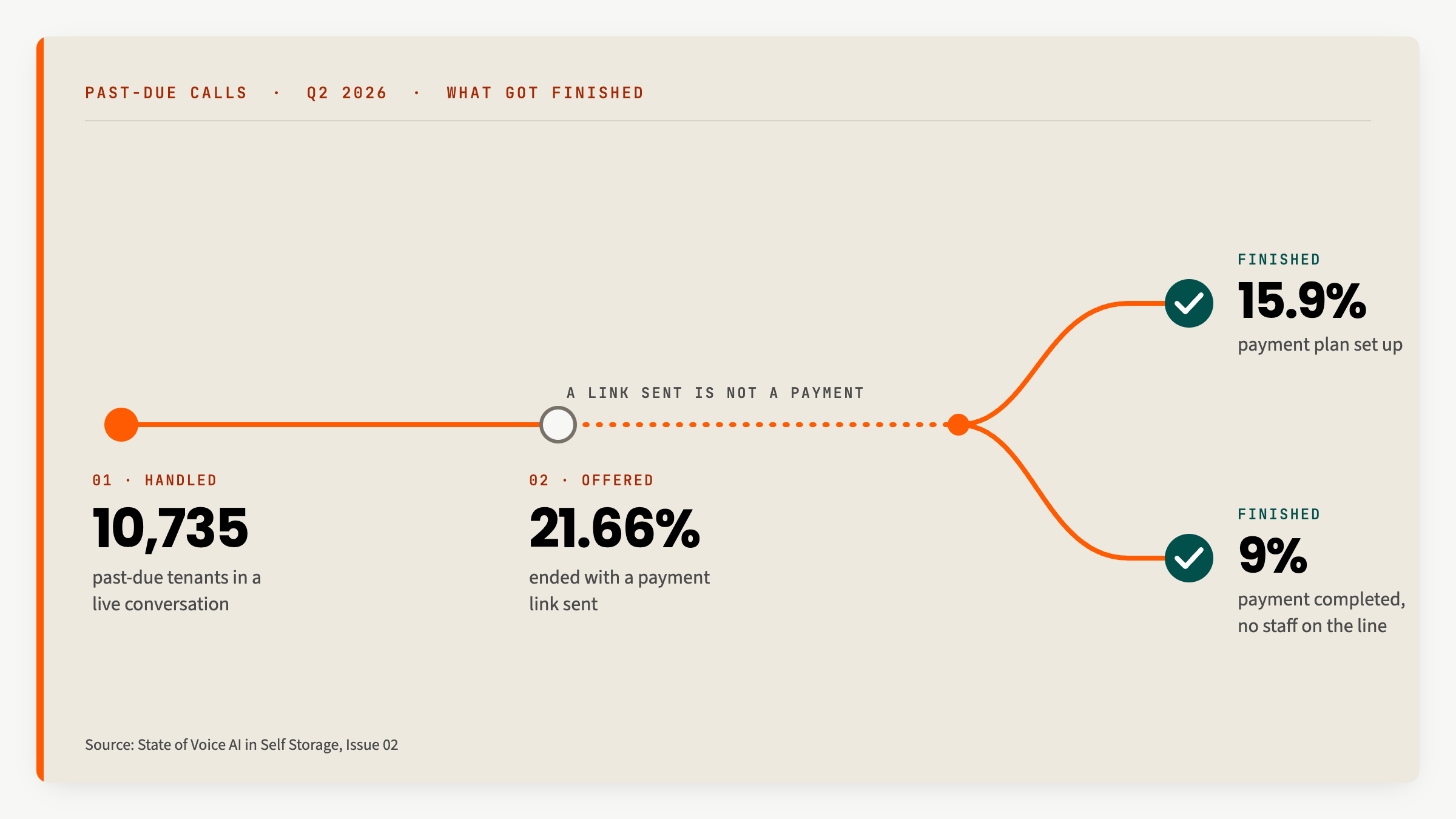
Look at the offered and finished lines side by side. 21.66% of those conversations ended with a payment link sent. 9% ended with a payment made. A link sent is activity. A payment posted is the job. We covered why a contained call isn't finished work in a separate post.
The sales side shows the same gap. Of calls that reached the sales agent, 48% discussed unit sizes and 32% completed a rental. Across the quarter, 956 rentals closed with voice as the last touch, at an average monthly rate of $108.67, and first contact to signed lease fell to 6.6 days, down from 8.7.
When the AI Should Hand Off
Hand off when the call needs judgment, an exception or authority the AI doesn't have:
- A discount beyond what's configured. The AI can quote your policy. It can't decide to bend it.
- A billing dispute. Someone on your team needs to look at the account and make the call.
- Damage or a break-in. The tenant needs a person, and the facility needs a record.
- An emergency. The AI follows your procedure, routes the call and opens a ticket. A person owns the outcome.
Everything else on the list above, the AI should finish.
Handing Off Without Losing Control
Operators who hold off on voice AI name two worries. The AI will say something you never approved. And when a call needs a person, the tenant will have to start over.
What the AI says is yours. Policy Builder drafts your setup from your website and your handbook. Then your team changes what the AI says, without asking us. Fix an answer once and it is fixed for every location.
When a call needs a person, the context goes with it. Many tenants ask for a person out of habit. The AI restates what it can do and asks for a shot. If the tenant still wants a person, or the situation calls for it, they go straight to your team. No loops. You set this per group. The handoff carries the caller's identity, the account, what they asked for, what was already tried and the reason for the handoff. Routing runs by location and role, so a lockout at one site reaches the group covering that site. A representative can jump into a live call with everything the AI already had.
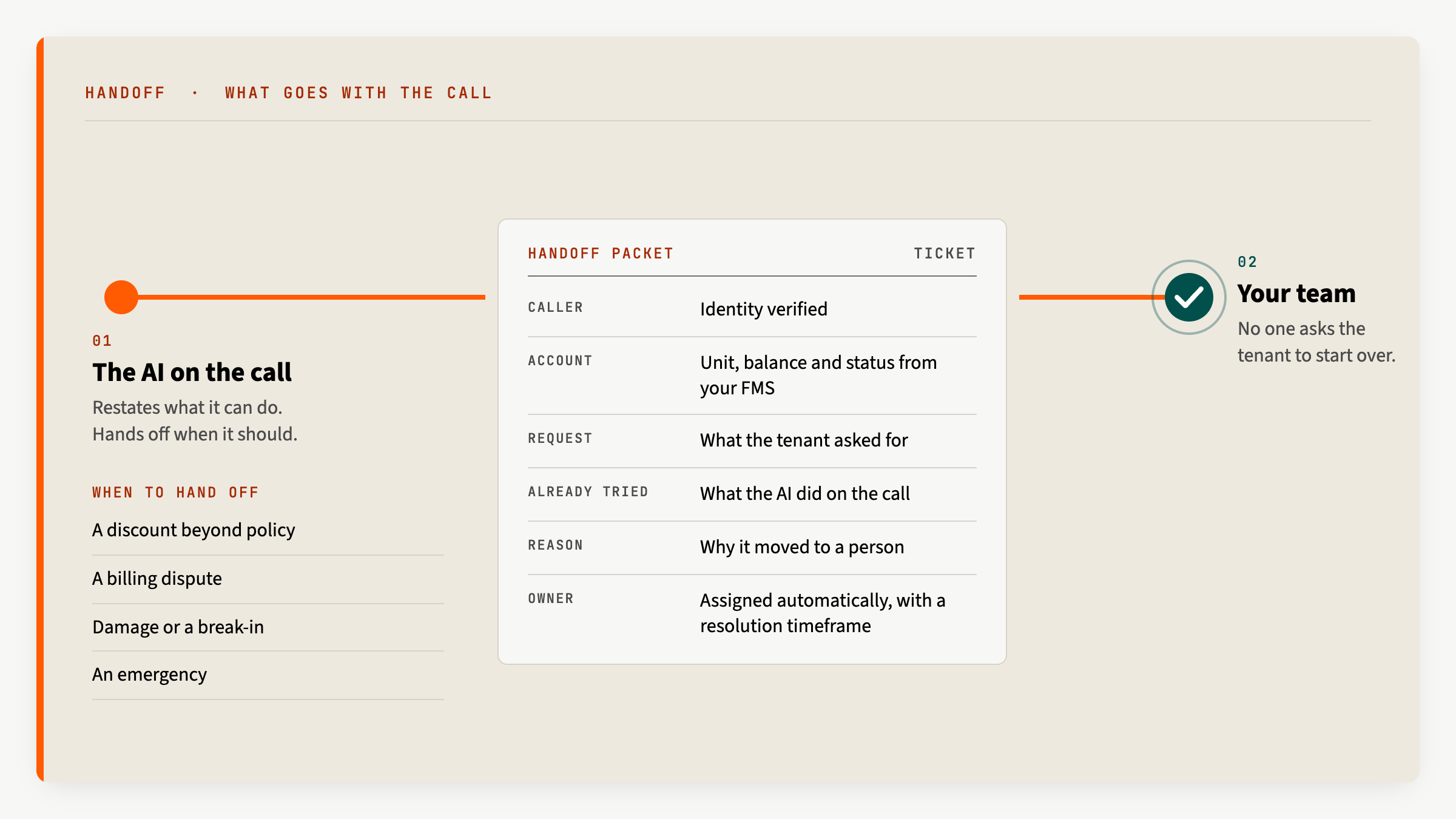
Work that outlives the call gets an owner. Tickets are assigned to an owner automatically, with a location, a resolution timeframe, notifications and the conversation attached. Every time someone on your team logs in, they see the work waiting on them. Ticket emails go to the location, a district manager or any address you choose, and the View ticket button opens it with no login.
The AI finishes what it can. Your team owns what it can't.
Expect the handoff number to move over time. Issue 02 found escalation rates fall from 24.5% in a facility's first 90 days to 14.8% at 90 to 180 days, then climb to 26.5% after 180 days. The climb is ticketing at work: mature facilities route more real work to people on purpose. Read escalation rate next to ticket volume and time to close, never alone.
Five Checks for Your Self-Service Setup
- Rewrite your greeting. Name the AI, list what it handles, then stop.
- Check that the AI reads account status before it gives a gate code. A code that does not open the gate means a second call.
- Close the payment loop. A past-due caller should be able to pay and get access in the same conversation.
- Check what the handoff carries. Identity, account, the request, what was tried and why it moved to a person. If your team has to ask again, the handoff failed.
- Give every ticket an owner and a due date. Work that outlives the call should never land in a shared inbox.
For how to measure all of this once it's running, see Contained Isn't Done.
The phone call was never the job. It was the part of the job that was easiest to see. Pick your five calls, define finished for each, and hold your voice AI to that standard.
Want to see it on your own calls? See it in Action