Voice AI
Collections Without a Collections Team: The First Pass
You don't need a collections team to work a past-due list. You need a first pass: the same early touches, on every account, every month, by text, call and payment link, with a person stepping in only where judgment is needed. swivl's State of Voice AI in Self Storage report, built on Q2 2026 data from 10,735 past-due conversations, found that the first three touches need consistency, not judgment. That's exactly what an AI can give you.
Most self storage operators don't have a collections team. They have a store manager with a past-due report, a phone and an afternoon that keeps getting taken by something else. A move-in walks through the door. A gate code call comes in. The report waits, and the balances age.
The State of Voice AI report called the delinquency list "the single largest pool of recoverable revenue most operators never touch." The fix it pointed to isn't a new hire. It's a first pass that runs the same way every time.
In this post
- Key terms: first pass, offered, completed, hand off
- Why the past-due list waits when managers work it by hand
- The first pass: three touches, each with a way to pay
- Count what got paid, not what got sent: Q2 2026 collections results
- Three operators collecting without a collections desk
- Where the first pass stops and your team takes over
- Five checks for your past-due list
Key Terms
- First pass. The routine, early touches on every past-due account: reminders, a call, a payment link, the offer of a plan. Same steps, same order, every account, every month.
- Offered. What the outreach put in front of the tenant: a payment link, an autopay link, a payment plan. It's activity.
- Completed. What the tenant actually did: a payment posted, a plan set up. It's the outcome.
- Hand off. The point where an account needs a person: a dispute, an exception to your policy, an account in lien.
Why the Past-Due List Waits
Working a real past-due list by hand means a manager on the phone most of a day, and most of those calls never reach a payment. So the work gets done in bursts. Some months every account gets a call. Some months the list waits until the late fee posts, through no fault of the manager.
Managers don't love the job, either. One multi-state operator told us late payments are an "operational noise maker" that "causes a lot of conflict in the field." The calls are repetitive, they're about money, and they pull a manager away from the renter standing at the counter.
Here's the thing about the early part of that list. The tenant who's three days late usually isn't refusing to pay. They forgot, their card expired, or they got paid on Friday. What they need is a reminder that reaches them on their time and a way to pay right then. That doesn't take judgment. It takes consistency.
The First Pass, Touch by Touch
A first pass is a short sequence that you set once and that runs on every account. You pick the days, the channels and how many touches an account gets, so outreach stays a reminder and never turns into a pile-on. swivl runs outbound text, voice calls and email from the same sequence, and every call is recorded in swivl with a summary, so your team sees what happened without asking.
Here's a first pass built the way the report recommends: automate the first three touches, keep them consistent, and finish each one with a way to act.
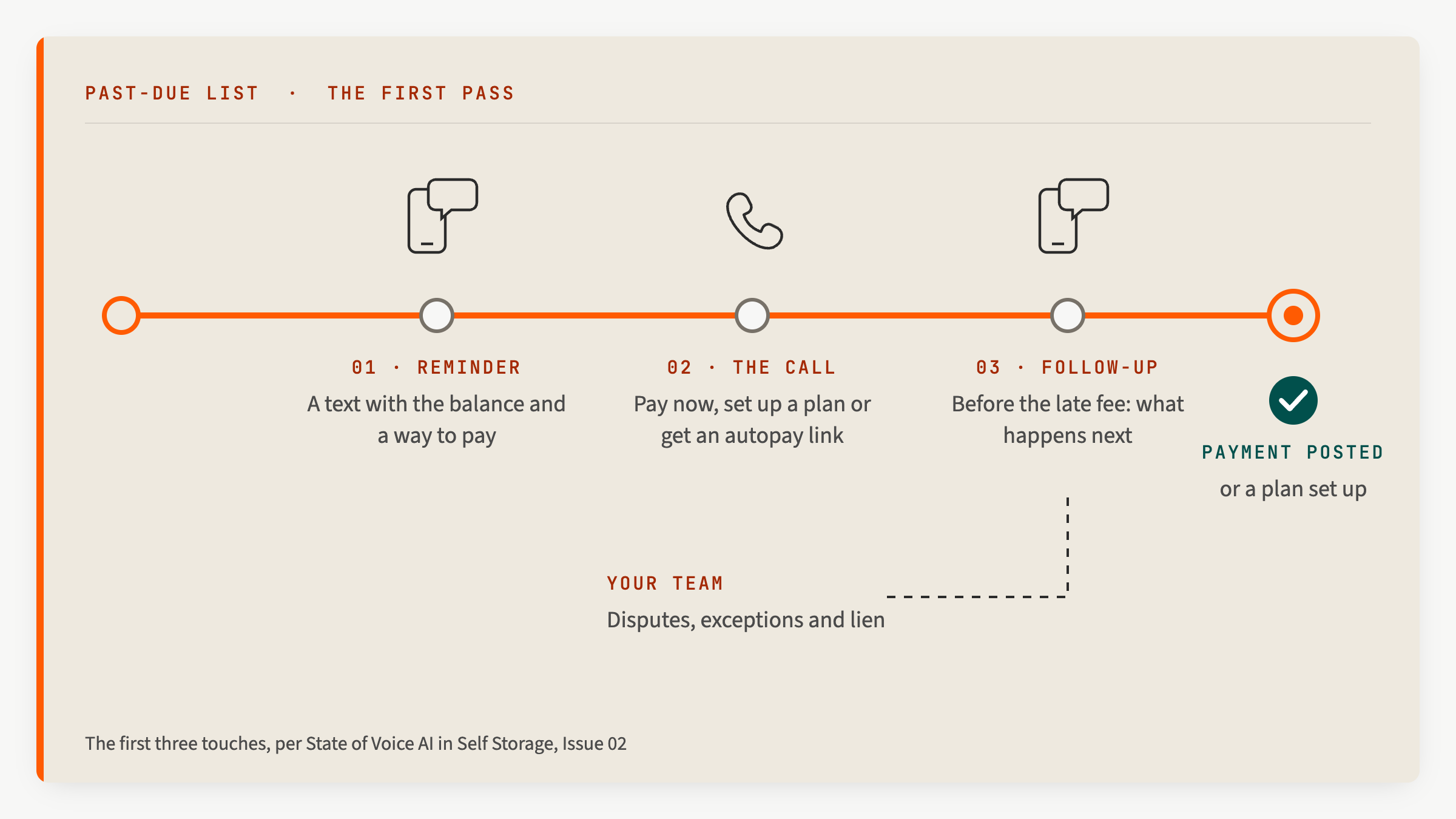
Touch 1: the reminder. A text a day or two after the due date, with the balance and a way to pay. Many tenants pay right here. On SiteLink, storEdge and SSM Cloud, that's a secure payment link through spot by swivl, with the account already open.
- Done when: the tenant pays, or the next touch is scheduled.
- Proof: the payment ledger in your FMS.
Touch 2: the call. A few days later, an outbound voice call. The AI confirms it's talking to the tenant, states the balance and asks what would help. If the tenant can pay, the same payment link goes out by text while they're still on the line. If they can't pay in full today, the AI offers what your policy allows, like a payment plan or an autopay link.
- Done when: the tenant pays, sets up a plan, or tells you when they'll pay.
- Proof: the ledger, the plan on the account, and the call summary in swivl.
Touch 3: the follow-up. Before the late fee, one more text or call that says what happens next and how to avoid it. Plain and polite, never a threat.
- Done when: the account is current, on a plan, or handed to a person.
- Proof: the account status in your FMS.
A tenant who doesn't pick up the call can still pay from the text. A tenant who ignores texts often answers a call. The report saw this across the network: conversations crossing voice and SMS grew about 26% over the prior three months. Outreach that can only travel on one channel leaves results on the table.
Count What Got Paid, Not What Got Sent
Some vendors report collections in volume: messages sent, calls placed, tenants reached. That's activity. It tells you the outreach ran. It doesn't tell you whether the balance came down.
swivl reports the halves separately. Here's Q2 2026 from our State of Voice AI report, split the way the report splits it:
What got handled
- 10,735 past-due tenants engaged in a live conversation.
- 94%+ needed no transfer to a person. 5.49% did.
What got offered
- 21.66% ended with a payment link sent.
- 5.17% ended with an autopay link sent.
What got completed
- 15.9% set up a payment plan on the call.
- 9% completed a payment, with no staff member on the line.
Collections outreach alone saved 427.71 hours of staff time.
The offered list is the flattering one. The completed list is the one that belongs on a board deck. In the report's words: "An offer sent is not a job finished." When you compare vendors, ask each one for the completed number. For more on why handled isn't finished, see Contained Isn't Done.
What It Looks Like at Three Operators
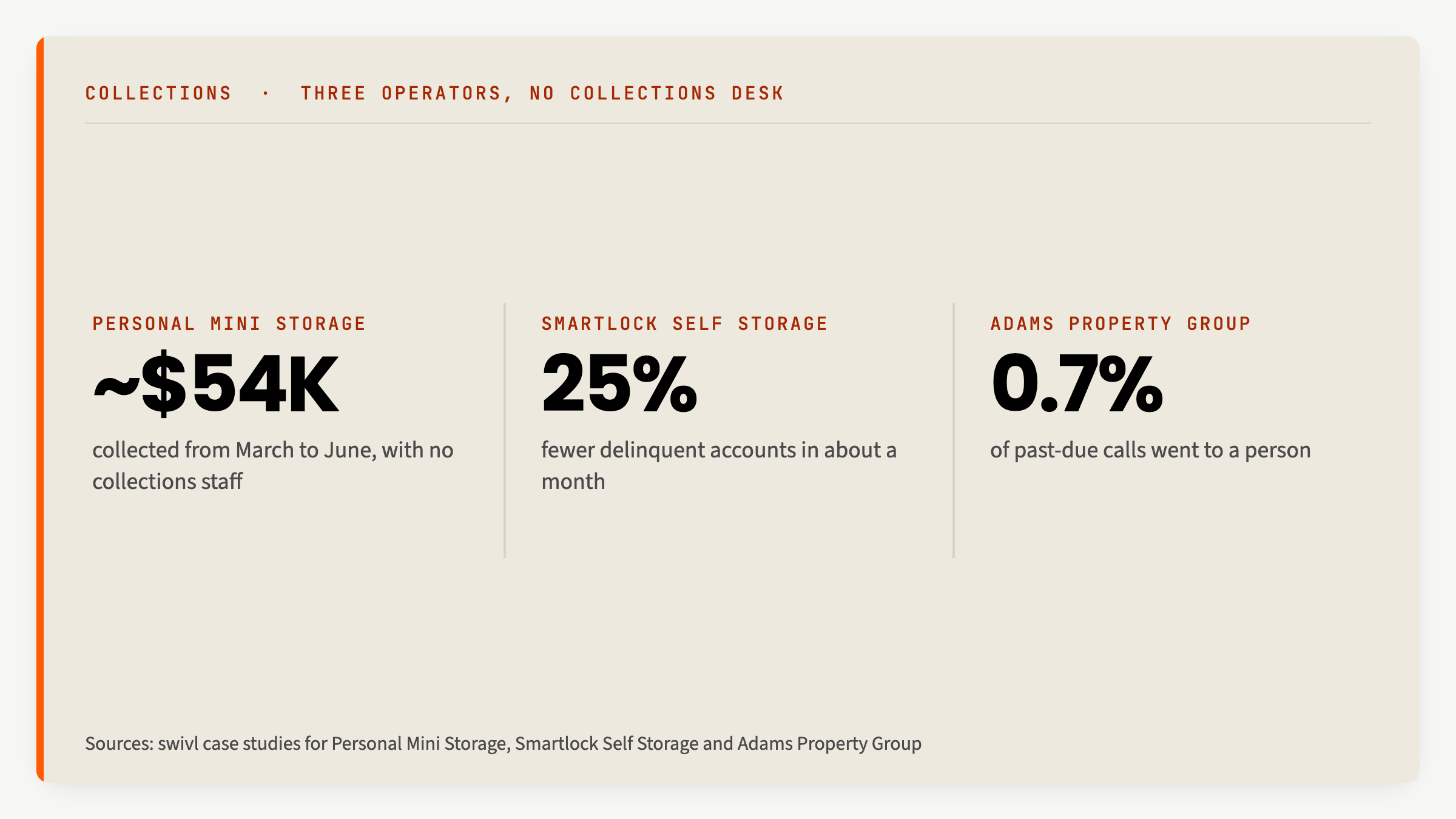
None of these operators added a collections desk.
Personal Mini Storage, 20 locations. No dedicated collections staff. From March through June 2026, swivl collected $54,241 across 345 completed payment sessions through spot.is Payments, about $157 a session. The work is almost entirely automated. Read the Personal Mini story.
Smartlock Self Storage, 13 locations. Outbound voice and SMS on past-due balances, with an automatic confirmation the moment a tenant commits to pay. In the first month, delinquent accounts fell from 167 to 125, about 25% fewer, and roughly $6,000 in past-due balances was recovered. 15% to 23% of AI calls ended in a payment plan. When a tenant says they plan to pay, their name goes to a daily sheet for Smartlock's COO, so the team skips the roughly $700 auction ad for people who were going to pay anyway. Taking the payment itself stays with Smartlock's team, by choice. Read the Smartlock story.
Adams Property Group, 24 locations, two brands. The team works past-due balances itself, and swivl runs the outreach alongside it by voice, SMS and email: 37,062 past-due calls worked since launch and 514 payment plans set up. Only 263 of those calls went to a person, a 0.7% transfer rate. Read the Adams story.
Three different setups. One pattern: the routine touches run without a person, and the team spends its time on the accounts that need one.
Where the First Pass Stops
A first pass is for the routine part of the list. Hand off when the account needs judgment, an exception or authority the AI doesn't have:
- A dispute. The tenant says the balance is wrong. Someone on your team needs to look at the account.
- An exception to your policy. A partial payment, a waived fee or a plan outside what you've configured. The AI can tell the tenant what your policy allows. It can't decide to bend it.
- Lien and auction. Accounts deep in the lien process follow your legal steps and your rules on how they can pay. That stage belongs to a person.
- A tenant who asks for a person. They get one. No loops.
When the account moves to your team, the context moves with it: who the tenant is, the balance, what was offered, what they said and why it was handed off. Tickets are assigned to an owner automatically, with a location and a due date, so the account doesn't sit in a shared inbox.
The AI works the list. Your team decides the exceptions.
Five Checks for Your Past-Due List
- Write your first pass down. Which days, which channel, what each touch says. If it lives in a manager's head, it runs when the manager has time.
- Put a way to pay in every touch. A reminder without a link is a reminder to call the office during office hours.
- Set your limits. Quiet hours, days you never reach out, a cap on touches per account, an opt-out that's honored, and a stop the moment the balance posts. A tenant who just paid and gets another reminder stops reading them.
- Decide where the first pass ends. Name the day or status where an account moves to a person, and what your team does with it.
- Report completed next to offered. Payments posted and plans set up, side by side with links sent. If you only see the first list, you don't know what the outreach earned.
For what the AI should finish on an inbound past-due call, see Self-Service Calls. For how to measure finished work, see Contained Isn't Done.
The past-due list doesn't need a collections team. It needs a first pass that runs every month, whether or not anyone has the afternoon free.
Want to see it on your own past-due list? See it in Action