Artificial Intelligence
Self Storage Voice AI: We Tested 6 Greetings on 2,770 Calls
We changed one sentence in our voice AI, the very first one callers hear, and ran six versions against 2,770 real calls to see which made the fewest people ask for a human.
The greeting we expected to win coached callers with example phrases, like "just say 'I need my gate code.'" It didn't just lose. It backfired. At one operator it pushed escalations up 6.9 percentage points, so callers reached for a human faster than they did with no real greeting at all.
The winner was quieter. It told callers what the AI could do, then got out of the way. Here's the whole experiment, the numbers, and the one line you can copy today.
What We Were Actually Testing
Every operator wants the same two things from voice AI: answer every call, and only pass a human the calls that truly need one. So the number that matters most is escalation rate, the share of callers who ask to be transferred to a person.
Our hypothesis was simple. If you tell callers what the AI can handle before they ask, fewer will reach for a human out of doubt. To test it cleanly, we ran six greetings across 18 locations for 60 days. Same operators, same window, one greeting per location. That cancels out seasonality and operator quirks, so the greeting is the only thing changing.
The Six Greetings
Here is exactly what callers heard. Read them back to back and you can almost feel which ones add friction
- Control, baseline: "Thank you for calling [Location]. How can I help you today?"
- Variant A, generic warm: "We're glad you reached [Location]! What can we help you with today?"
- Variant B, names the AI: "Thank you for calling [Location]! I'm [assistant name], your AI assistant. I'm here to help. What can I do for you today?"
- Variant C, names the AI and lists what it can do (winner): "Thank you for calling [Location]! I'm [assistant name], your AI assistant. I can help with gate access codes, payments, reservations, move-outs, and more. What can I help you with today?"
- Variant D, example phrases: "Thank you for calling [Location]! To get started, just say something like 'I need my gate code,' 'I have a billing question,' or 'I'd like to rent a unit.' What can I help you with?"
- Variant E, AI plus example phrases: "Thank you for calling [Location]! I'm [assistant name], your AI assistant. To get started, just say something like 'I need my gate code' or 'I have a billing question.' What can I help you with?"
How We Scored Them
Four metrics, each catching a different way the greeting could fail.
- Escalation rate (primary): share of calls where the caller asked for, or got routed to, a live agent. Lower is better.
- Reflex escalation rate: escalations in the very first exchange, before the AI got a real turn. This isolates whether the opening line itself creates doubt.
- Time to first escalation: how long callers stayed before asking for a person. Longer is better.
- Containment rate: calls the AI resolved end to end, with no transfer at all.
The Results, Backfires and All
Every number below is the change in escalations versus the plain control at the same operator. Negative is good. It means fewer people bailed to a human.

Values are percentage-point change vs. control. Three things jump out.
The "helpful" greetings hurt. Both D and E, the ones that fed callers example phrases, pushed escalations up. Handing someone a script turns a phone call into a quiz. If what they need isn't on the list you just read, they assume the bot can't help and ask for a person.
A great score at one site can hide your worst option. Look at Variant E. At Org 2 it looked incredible, escalations down 3.3 points and reflex down 7.3. At Org 1 it was the single worst greeting we ran, up 6.9 and up 9.2. Test it at only one location and you might roll out your worst performer everywhere.
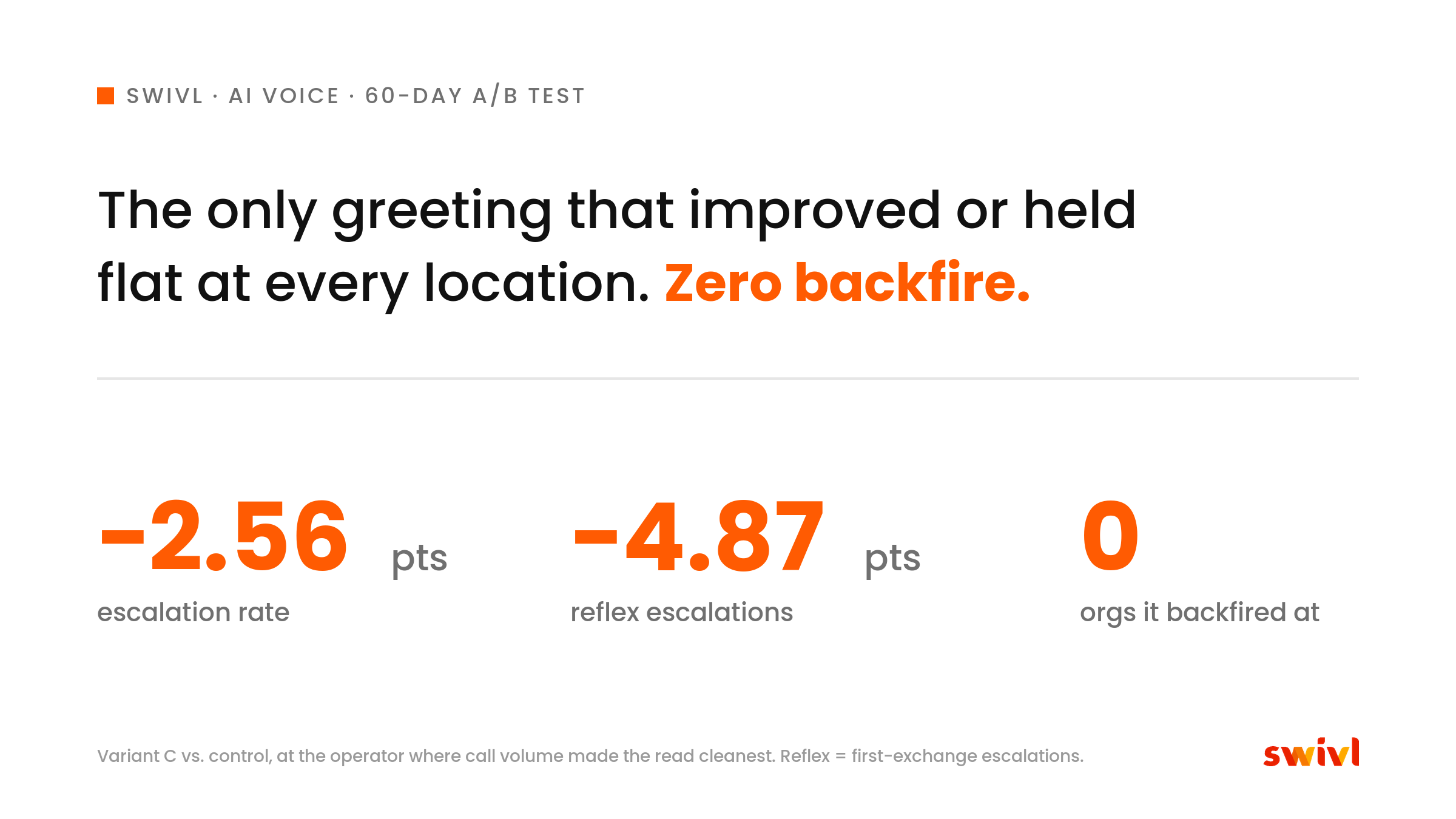
Variant C was the only one that traveled. It improved or held flat at every operator, with zero backfire. At the location where call volume made the read cleanest, it cut escalations by 2.56 points and reflex escalations by 4.87. Not the flashiest single number, but the only greeting you can trust across the board.
The only greeting that improved or held flat at every location. Zero backfire.
Why "Tell Them What You Do" Wins
A caller's real first question is never said out loud: can this thing actually help me? Variant C answers it in the first second by naming the exact jobs it handles. The caller hears their reason for calling and stays.
Example phrases try to be helpful and do the opposite. They put the work on the caller to phrase things right, and they make the AI feel rigid. Warmth alone (Variant A) doesn't help either, because "we're so glad you called" still tells no one what's possible.
Naming the assistant adds the last bit. Variant C beat Variant B, which named the AI but stopped there. Say it's AI, say what it does, then stop. (Yes, callers still trust it when you disclose the AI.) Disclosure builds trust, the capability list builds confidence, and callers reward both by staying on the line instead of tying up your staff with routine questions.
The Line You Can Copy Today
Two steps, and the first one needs no setup.
Now: make this your default greeting. It works with zero configuration.
"Thank you for calling [Location]! I can help with gate access codes, payments and balances, unit reservations, move-outs, and more. What can I help you with today?"
Why not the full winner right away? If an operator hasn't set a name for their assistant, the name slot renders blank and the greeting breaks mid-sentence. The nameless capability list sidesteps that, so it ships as the safe default.
Next: set an assistant name. That one setting unlocks the full Variant C, adds the trust lift from naming the AI, and takes about a minute.
The Takeaway
The lesson isn't "be warmer" or "say more." It's tell callers exactly what the AI can do, then get out of the way. Everything past that is homework, and homework is what sends people reaching for a human.
Ready to Try This on Your Own Calls
The winning greeting is one line of configuration, not a new model. See what it does to your escalation rate, along with everything else swivl's Voice AI handles after hours.
Book a demo with the swivl team.
.jpg)