
Marketing
Self Storage Marketing Plan: 90-Day, Data-Backed Playbook From The SSA Demand Study
Most self-storage operators either wing their marketing entirely or copy whatever discount the competitor down the street is running this month. Neither approach works! One produces inconsistent occupancy and the other is a race to the bottom.
What operators really need is a self-storage marketing plan built on real data and executable by a manager without a marketing degree.
The SSA Demand Study gives us that data. Combined with field experience across hundreds of facilities, it points to a plan organized around four movements…
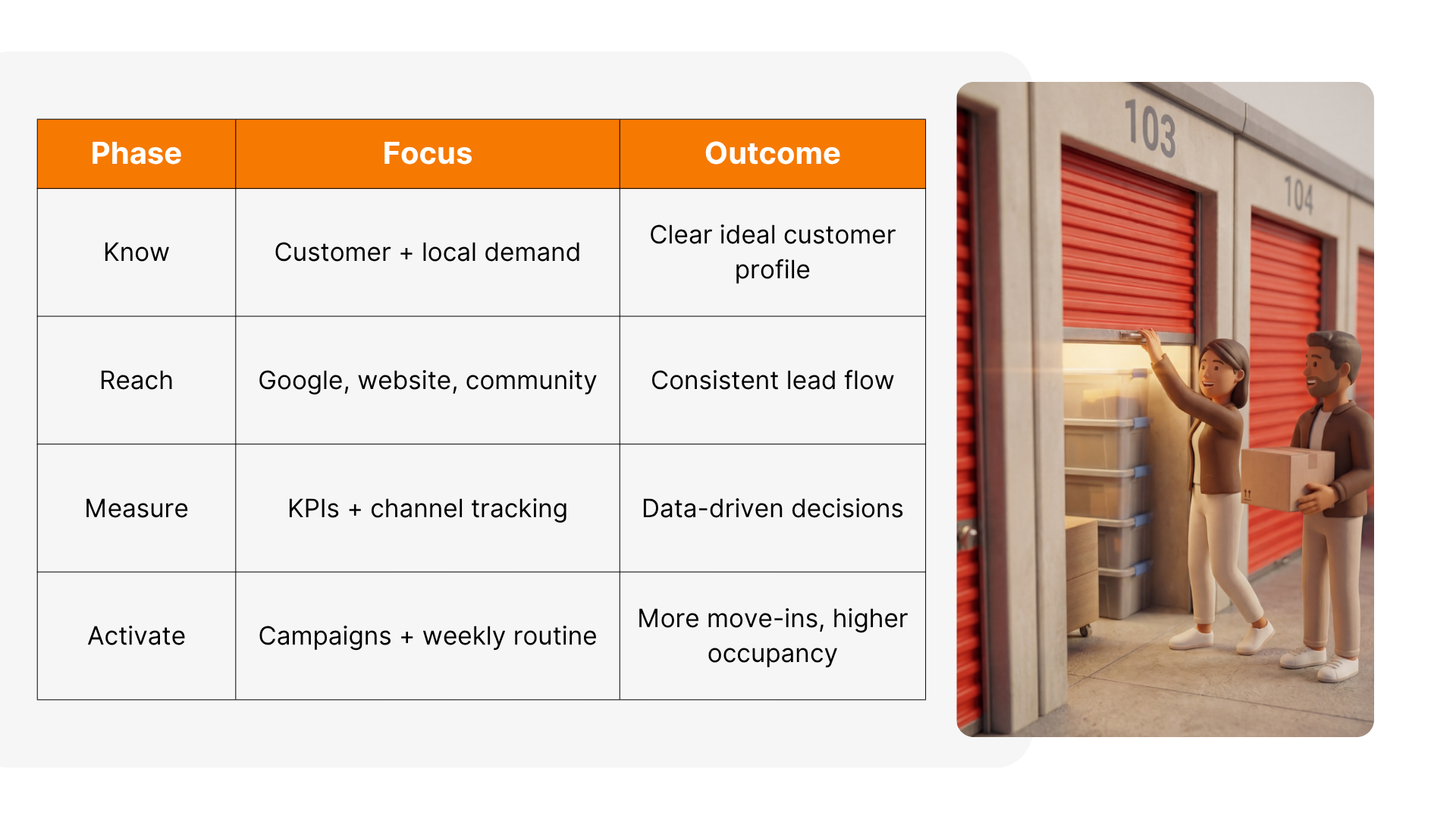
- Know
- Reach
- Measure
- Activate.
Straight off the bat, here's how you’re going to build it in 90 days.
Here’s Your 90-Day Self-Storage Marketing Plan…
Step 1 - Know Your Customer Before You Spend A Dollar
Start With The National Numbers
The SSA Demand Study puts household penetration at 12.6%. So, that’s roughly one in eight American households.
The average renter has a household income of around $94K, 60% own their home, and 72% live in single-family houses.
The number one reason they rent storage is that they've run out of room at home, not because they're in the middle of a move.
I think operators often forget how much that changes the marketing conversation.
If your messaging is built around moving, you're talking past the majority of your actual prospects.
They want security, convenience, and to feel like they're being treated well by an operation that takes care of its property.
Layer On Generational Differences
The study breaks down meaningfully by generation and the differences matter for channel and message selection.
Here’s what you need to know…
- Gen Z renters stay 3 to 6 months, buy more add-ons like boxes and insurance, and live on mobile, TikTok, and Instagram.
- Millennials make up roughly 35-37% of renters, stay one to two years, and strongly prefer digital convenience and online rentals.
- Gen X and Boomers stay the longest, often two-plus years, and respond to cleanliness, trust signals, and phone or in-person interaction.
If your trade area skews younger, your plan needs a stronger digital presence and a smoother online rental flow.
When it skews slightly older, your Google Business Profile, phone answering rate, and condition of your facility matter way more than your Instagram strategy.
Build A One-Page Ideal Customer Profile
Before spending a dollar, I recommend taking 20 minutes to sketch out who you're really selling to.
You should think about…
- Approximate age band mix
- The primary reasons your customers rent
- Typical drive time
- Your most-rented unit sizes
This one page becomes the filter every marketing decision runs through.
Step 2 - Map Your 20-Minute Marketing Universe
The SSA data shows that 68% of tenants travel under 20 minutes to their unit. 91% describe that travel time as satisfactory. What does this mean? Well, your self-storage marketing plan has a geographic boundary… and it's roughly a 20-minute drive from your front gate!
From our conversations with operators, most of them know this intuitively.
I want you to pull your customer addresses, drop them into Google My Maps or your software's customer map, and look for two things…
- Pockets inside that 20-minute band where you have no customers.
- Clusters of business customers who might be worth a dedicated B2B outreach effort.
Contractors, funeral homes, relocation coordinators, and HR departments at large employers are all worth a conversation about larger units, drive-up access, and digital key sharing.
Step 3 - Build A Google-First, Mobile-First Foundation
It’s no secret that this is the core of any self-storage marketing plan right now in 2026. From what I’ve seen, it’s also where many operators have the most room to improve quickly.
Your Google Business Profile Is Non-Negotiable
I want you to check your hours, phone number, and address first. Manager turnover and seasonal hour changes create errors that cost you leads daily without anyone noticing.
Then look at your photos! We know that recent images of your gate, keypad, camera coverage, and clean drive aisles communicate security and maintenance way more effectively than any ad copy.
Oh, and let’s not forget reviews…
The SSA data shows 88% of people trust online reviews as much as personal referrals. A single one-star review takes roughly 19 five-star reviews to offset. Yikes.
You need to make a habit of asking every new tenant for a review right after lease signing.
You must also have a team member responding to every review. Yes, even the negative ones. Prospective tenants are looking to see how you take care of problems.
Fix Your Website For How People Really Shop
42% of prospects find you through web search. Here’s how that breaks down…
- 58% of those are on mobile.
- 67% rent from the first facility they contact.
The math on a broken website is pretty brutal. Every friction point creates an open opportunity for your local competitors. It’s so easy for prospective tenants to click around and explore their options.
Your site needs three things:
- Transparent, all-in pricing with no hidden admin fees.
- Security and access information to build confidence.
- A clear path to rent or reserve online.
- Photos that show what the facility really looks like.
If any of those are missing, I want you to fix them before running a single paid ad.
Step 4 - Add Community & Referral Marketing
The SSA data from operators shows roughly 48% of traffic coming from their website and around 23% from what the session framed as RREM: Repeats, Referrals, Events, and Marketing.
That second bucket is chronically underused and usually fairly inexpensive.
It's interesting to see how often operators skip this entirely because it feels less scalable than digital.
A half-day visiting 10 to 15 referral partners, realtors, apartment managers, HR departments at large employers, and relocation coordinators, can generate a steady stream of warm referrals for months!
Off the top of my head, here are three worthwhile ideas:
- Drop off a swag bag with referral cards.
- Offer a $50 to $100 referral bonus.
- Leave a simple one-page flyer with a map and your unit sizes.
For contractors and business customers, you should mention drive-up access, smart locks, digital key sharing, and 24/7 availability.
And then for funeral homes and estate professionals, pitch long-term family storage or inventory storage.
Events also belong in your 90-day plan. I’ve got another three ideas for you:
- Yard sale days at the facility
- Food truck days
- Heavy seasonal decoration
Those ideas increase drive-by awareness and give your team something worth posting about. I’m sure you can come up with some more inventive ones.
Step 5 - Track These Numbers Carefully On A Spreadsheet
I've always found that operators who struggle with marketing aren't usually running bad campaigns. That’s not the issue.
They just don’t have a feedback loop! So, if that’s you, here are metrics you should start tracking on a spreadsheet:
Physical Occupancy & Economic Occupancy Are Not The Same
Physical tells you how full you are and economic occupancy tells you how profitable they are. Chasing 99% physical at suppressed rates is a trap that shows up in one number but not the other.
Revenue Per Square Foot Tells You If Your Pricing Really Works
Revenue per square foot is gross rent divided by rentable square footage. If occupancy rises, but this number doesn't, your pricing is off!
Leads & Conversion By Channel Show You Where Your Money Is Going
Walk-ins should close around 70%. Calls need to be tracked for answer rate and conversion and web leads need a count and a conversion rate.
The blended benchmark from the session: 13,500-plus leads at 53% conversion.
Marketing Cost Per Move-In Cannot Be Overlooked
This is spend divided by move-ins per channel. Cost per lead is a vanity metric; cost per move-in is the real one.
Move-In & Move-Out Net Change Tells You What's Happening Week To Week
Weekly net gain or loss compared to the same week last year separates genuine problems from seasonality.
Set up a simple dashboard and spend five minutes on it every week.
I’ve made a dashboard template for you.
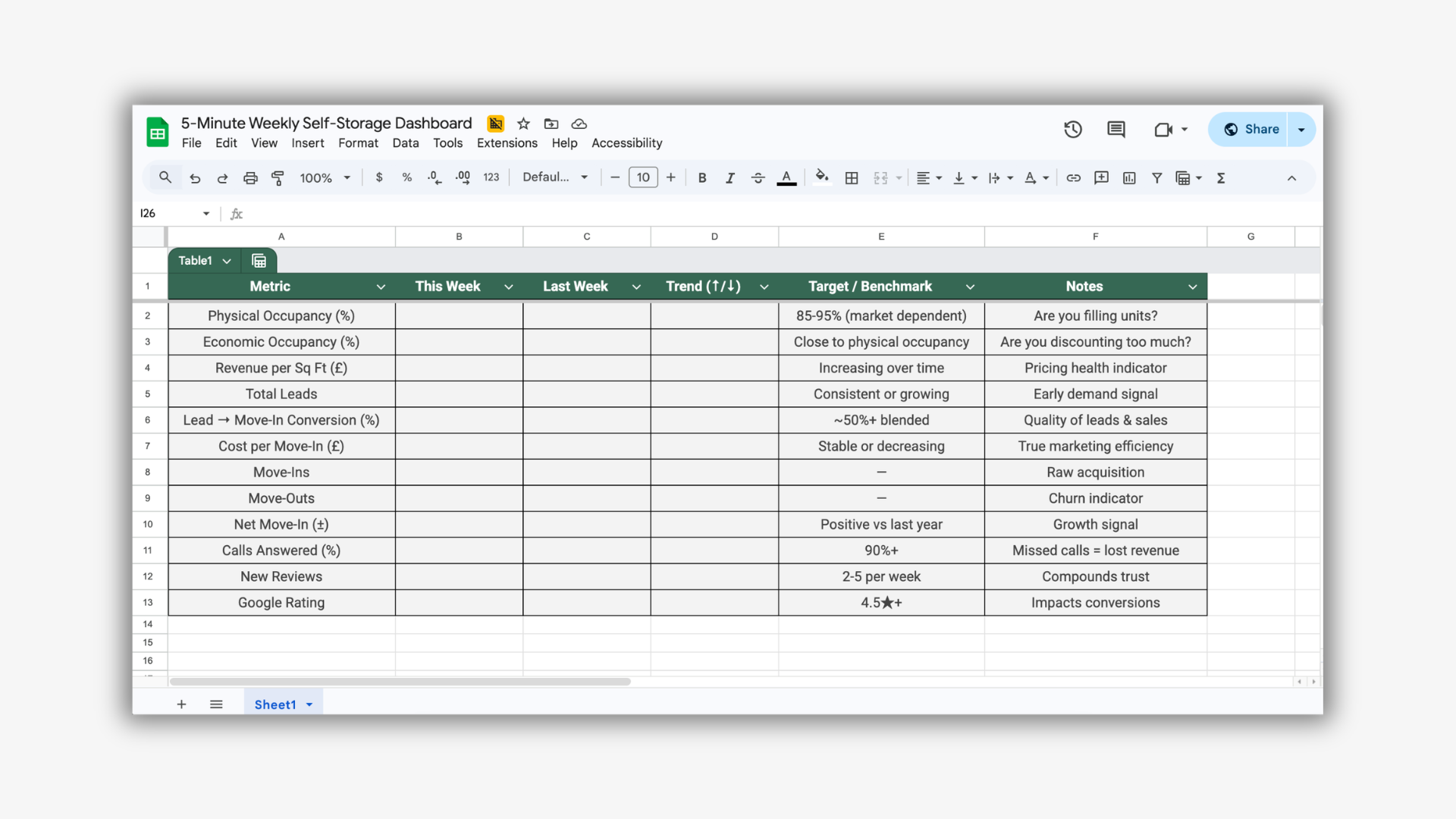
The pattern across 8 to 12 weeks will tell you more than any consultant ever could.
The 90-Day Self-Storage Marketing Sprint
Days 1-30 Are All About Fixing The Foundations
Claim and clean up your Google Business Profile, update your website with clear pricing and rent/reserve paths, and start tracking leads by channel and daily move-ins and move-outs.
In these first few days, I want you to create a one-page ideal customer profile and get a basic KPI spreadsheet up and running.
Days 31-60: Let’s Turn Up Visibility!
You can launch modest Google Ads for your one or two best revenue unit sizes, run at least two boosted social posts focused on events or useful local content, hold one community event, and visit your top 10 to 15 referral partners.
I think you should set a target of 10 to 20 new reviews. During this time, you should also get your first event documented with attendance and any rentals attributed.
Days 61-90: Optimize & Raise Rates
Use two months of data to shift spend toward channels producing move-ins, identify unit sizes above 90% occupancy, and push street rates on those sizes incrementally.
Implement rolling customer rate increases rather than hitting everyone in one month. You must track documented occupancy change, revenue per square foot trend, and cost per move-in by channel.
You’ll Need A Weekly Routine To Keep It All Running
A plan that only runs during a 90-day sprint isn't a plan.
Spend 15 minutes daily checking missed calls and returning them, scanning new web leads and responding within 5 minutes where possible, and doing a quick walk of your property for cleanliness, signage, and lighting.
Also, spend 30 minutes weekly updating your five-metric dashboard, secret shopping one competitor or reviewing a handful of recorded calls, and posting one social update.
When I speak with operators who sustain strong occupancy over time, this kind of weekly rhythm is almost always what's underneath it.
The 90-day sprint builds the machine and the weekly routine keeps it running!
swivl supports this exact workflow by consolidating calls, texts, web chat, and emails into one platform, so nothing slips between the cracks during the daily 15-minute check.
If lead response time and missed call recovery are bottlenecks in your current operation, you need to see what that looks like when it's automated. Book a demo with the swivl team today.
.jpg)


.jpg)