Customer Experience
Self-Storage Payment Automation: Here's The Honest Truth About Late Fees
I've spent enough time talking to self-storage payment automation skeptics to know that most late fees aren't actually a collections problem.
Facility owners tend to frame late payments as a tenant behavior issue.
The tenant didn't pay on time, so the late fee kicks in, and now you're either collecting it or having an uncomfortable conversation about waiving it.
That cycle repeats every month across a percentage of your tenant base and most owners accept it as a cost of doing business.
From what I’ve seen, the facilities running the leanest, most consistent collections automate the moments that prevent the problem from happening in the first place
They’re not necessarily stricter about enforcement.
The difference in outcomes is significant enough that it's worth being honest about what manual collections processes are actually costing you.
Most Late Payments Were Preventable And You Know It
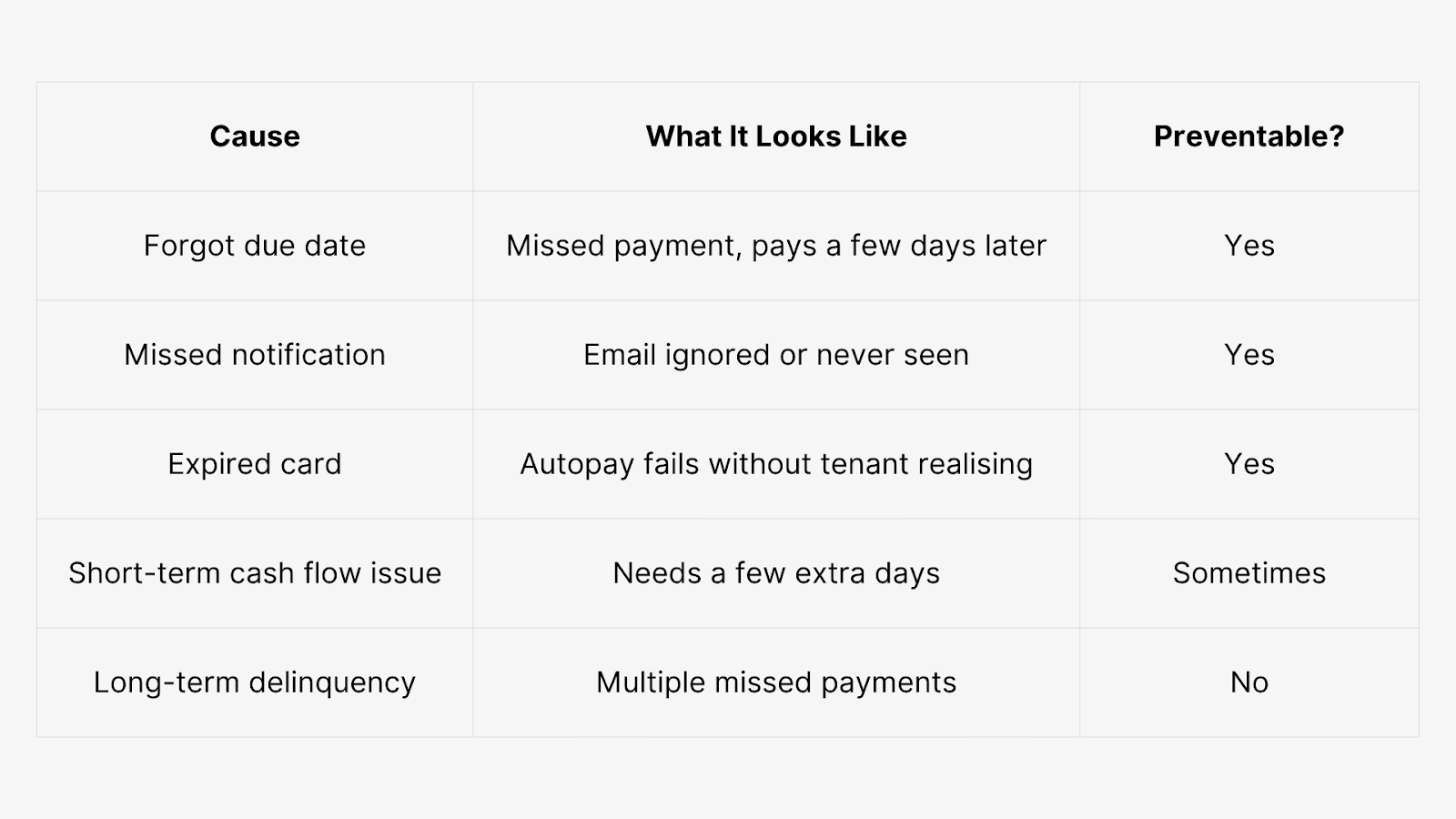
The honest truth about late fees in self-storage is that the majority of them are generated by forgetfulness.
Tenants who pay late every few months aren't usually struggling to afford their unit.
It’s usually something like…
- They forgot the due date.
- Missed a notification.
- Their card on file expired.
…and nobody flagged it until the system locked them out.
I think people often forget that a late fee recovered is still a worse outcome than a payment made on time.
The fee creates friction.
The tenant feels penalized for something they consider a minor oversight and your staff spends time on a collections conversation that didn't need to happen.
Everyone loses a little, every time.
Payment automation addresses the root cause rather than just collecting on the symptom.
Here's What Actually Happens When You Automate Payment Reminders…
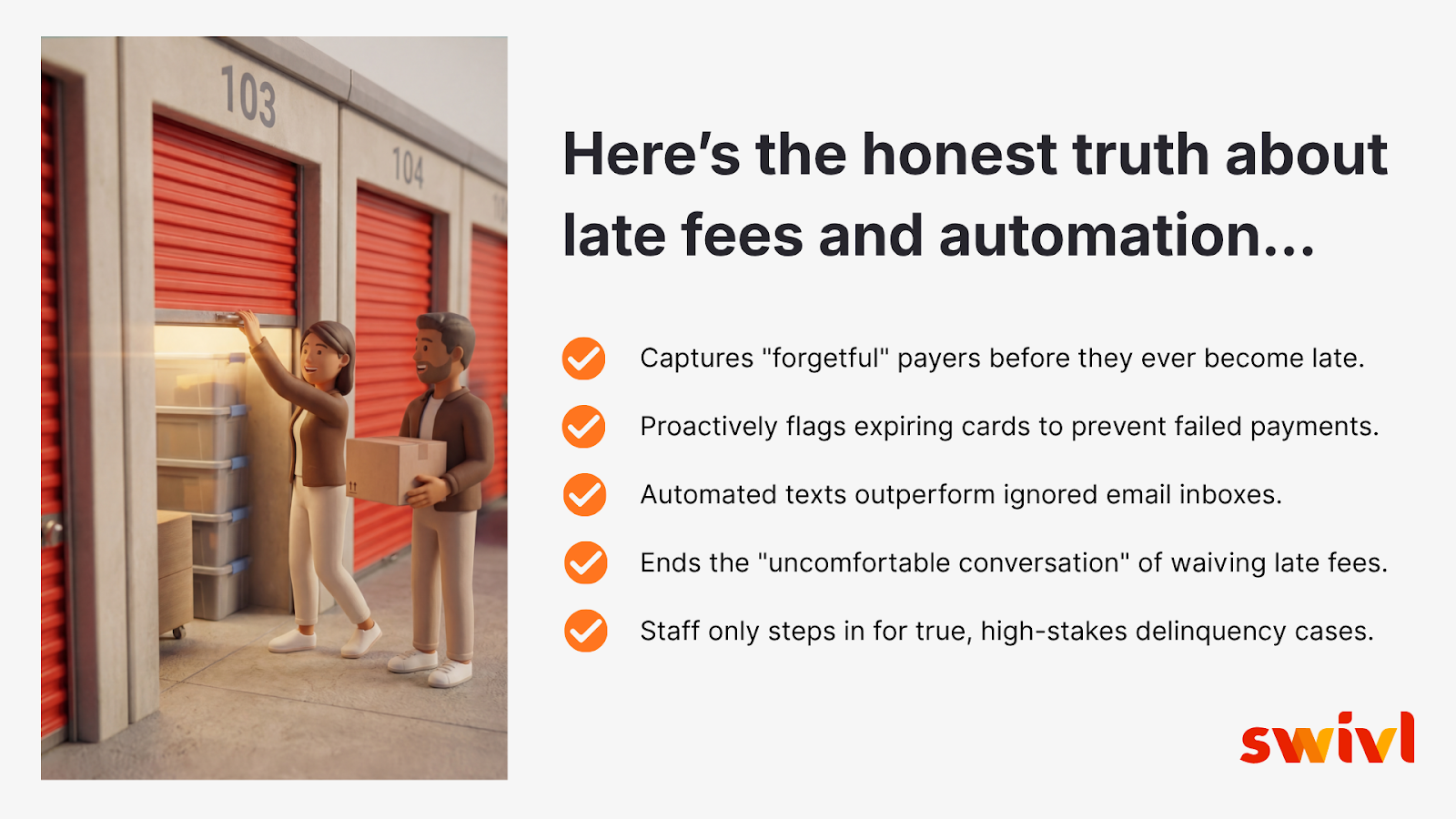
The most immediate impact of automated payment communication is the reduction in late payments from tenants who simply forgot.
A well-timed reminder sequence, one that goes out several days before the due date, the day before, and on the day itself, captures the vast majority of forgetful payers before they ever become late.
swivl takes care of this through its Billing Agent, which runs automated payment reminders and collections sequences across text, email, and chat without any manual intervention from your team.
The messages go out on schedule, they're personalized with the tenant's name and account details, and they reach tenants on the channel they actually check.
I'm generally wary of operators who tell me their tenants don't respond to texts about billing.
When I speak with facility owners using swivl's Billing Agent, the data tells a different story…
Automated SMS reminders consistently outperform email for payment response rates because tenants see them in-the-moment rather than when they eventually get around to their inbox.
The Card Expiry Problem Nobody Talks About Enough
A significant and underappreciated source of late payments is expired payment methods that nobody updated because the tenant never thought to.
This plays out the same way at most facilities…
- A tenant set up autopay two years ago and forgot it exists.
- Their card expires and the payment fails silently.
- The system generates a late fee and the tenant gets locked out.
- You get an angry phone call from someone who genuinely believed they were current.
It's interesting to see how much of a facility's monthly late fee volume traces back to this single issue once you pull the data.
Automated outreach that proactively checks in with tenants about expiring payment methods, before the failure happens, removes a category of late payments that enforcement can never fix because the tenant didn't do anything wrong.
swivl's automated outreach can be configured to flag and message tenants ahead of card expiry, giving them time to update their details without ever hitting a failed payment.
For most facilities, this alone justifies the investment in automation.
What Manual Collections Is Really Costing You
Facility owners often think about late fees as revenue. I've always found it more useful to think about the full cost of the manual collections process that surrounds them.
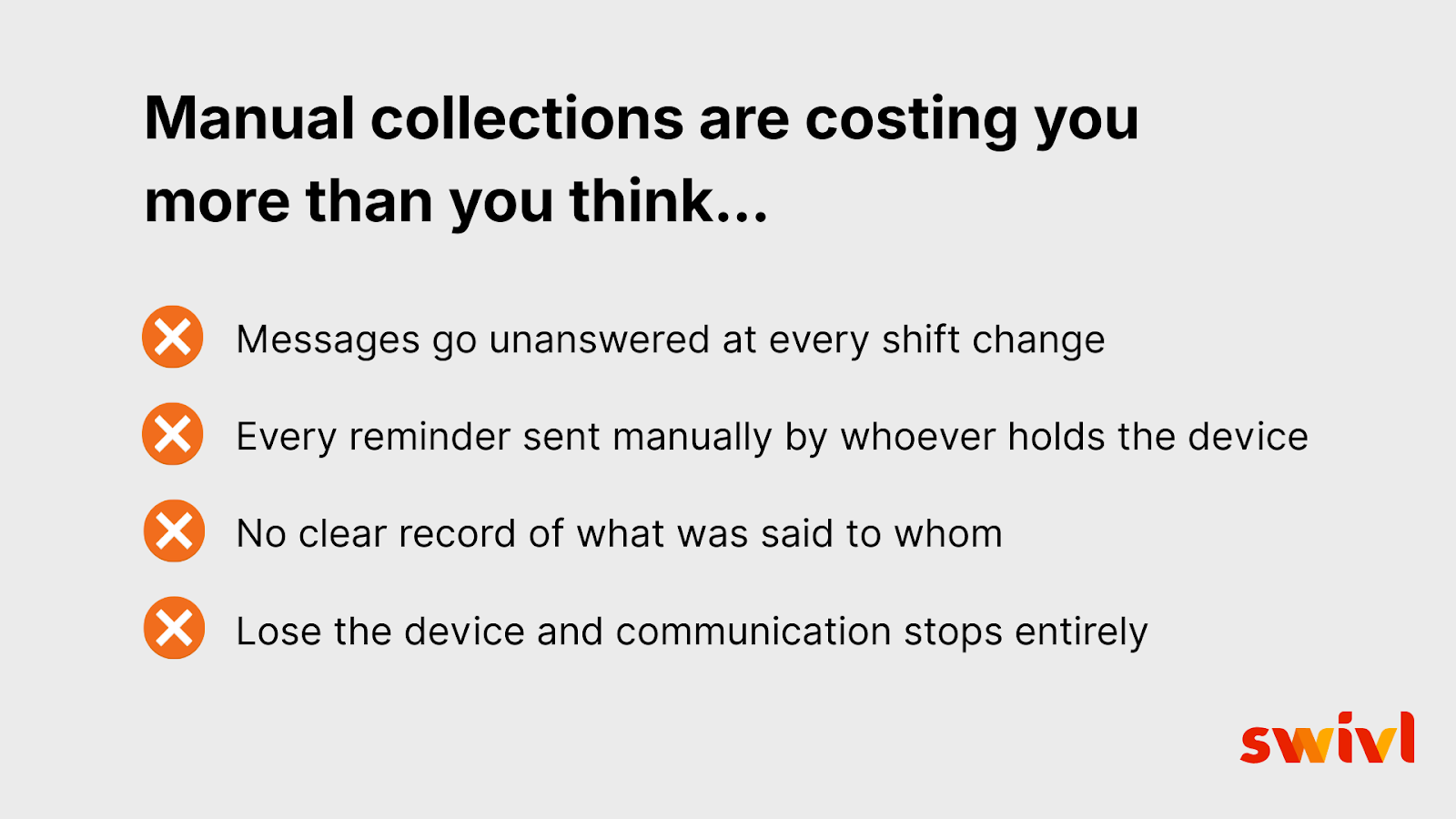
Your staff member spends time identifying who is late, pulling up their account, placing a call or sending an email, waiting for a response, following up when there isn't one, and then either collecting the payment or entering into a negotiation about waiving the fee.
Multiply that across every late account, every month… and the labor cost is substantial!
Beyond the direct labor, there's the opportunity cost.
Every hour your team spends on routine collections is an hour they're not spending on leasing conversations, facility management, or tenant relationships that drive long-term retention.
The work that automation does well is exactly the work that shouldn't require a human in the first place.
When Enforcement Is Actually The Way Forward
I want to be clear… payment automation doesn't replace the need for a clear late fee policy and consistent enforcement.
For tenants who are genuinely delinquent, behind by multiple months, or unresponsive to automated outreach, escalation to human follow-up and eventually the lien process is appropriate and necessary.
The value of automation here is triage.
When swivl takes care of the routine reminders and payment nudges automatically, your team's attention is freed for the accounts that genuinely need human judgment.
The delinquent tenant who needs a real conversation gets one, rather than your staff being buried in reminder calls for tenants who just forgot to update their card.
The Facilities Getting Self-Storage Payment Automation Right…
I’ve found that the operators seeing the strongest results from payment automation share a few traits.
They have…
- Configured reminder sequences to go out early enough to prevent late payments rather than just announce them.
- Connected their payment systems to their communications platform so outreach triggers automatically by account status.
- Stopped measuring success by late fee revenue and started measuring it by on-time payment rate.
swivl consolidates all of this into a single platform where your Billing Agent runs continuously across every tenant account, every channel, and every stage of the payment lifecycle.
The goal is to generate fewer late fees while recovering more of what's genuinely owed, faster and with less friction for everyone involved!
Book a demo with the swivl team today and see what payment automation looks like when it's built specifically for self-storage.
.jpg)